-
24-12-23 Summary of Changes
-
SECONDARY RFP COVER AND MAIN TEMPLATE
- COVER PAGE
-
1. OVERVIEW
-
2. RULES AND CONDITIONS
- 2.1. INTRODUCTION
- 2.2. COMMITMENT
- 2.3. CONFLICT OF INTEREST AND FOLLOW-ON CONTRACTS
- 2.4. ANTITRUST CLAIMS
- 2.5. CONTRACTOR’S COST
- 2.6. PUBLIC RECORDS ACT
- 2.7. WRITTEN QUESTIONS
- 2.8. ADDENDA
- 2.9. MODIFICATION OF SUBMITTALS
- 2.10. ERRORS IN SUBMITTALS
- 2.11. UNRELIABLE LIST
- 2.12. ELECTRONIC WASTE RECYCLING
- 2.13. USE TAX
- 2.14. SUBCONTRACTORS
- 2.15. PAYMENTS TO THE CONTRACTOR
- 2.16. EQUIPMENT AND SOFTWARE PURCHASES
- 2.17. PROPOSERS CONFERENCE
-
3. PROPOSAL SUBMITTAL REQUIREMENTS
- 3.1. INTRODUCTION
- 3.2. DEADLINE
- 3.3. COVER LETTER
- 3.4. SUMMARY
- 3.5. METHODOLOGY
- 3.6. ORGANIZATION
- 3.7. QUALIFICATIONS AND RESOURCES
- 3.8. REFERENCES
- 3.9. SAMPLES OF WRITTEN WORK
- 3.10. CONTRACTOR ELIGIBILITY
- 3.11. QUALIFICATIONS/LICENSES
- 3.12. SMALL BUSINESS (SB) PARTICIPATION
- 3.13. SMALL BUSINESS (SB) PREFERENCE APPLICATION
- 3.14. DISABLED VETERAN BUSINESS ENTERPRISE (DVBE) PARTICIPATION
- 3.15. DISABLED VETERAN BUSINESS ENTERPRISE (DVBE) INCENTIVE APPLICATION
- 3.16. SB/DVBE REPORTING REQUIREMENT
- 3.17. SB/DVBE RESOURCES
- 3.18. TARGET AREA CONTRACT PREFERENCE ACT (TACPA)
- 3.19. RULES FOR AWARD
-
4. COST PROPOSAL SUBMITTAL
-
5. EVALUATION AND SELECTION
- 6. DEFINITION AND TERMS
-
ATTACHMENT 1: DISABLED VETERAN BUSINESS ENTERPRISE DECLARATIONS
- ATTACHMENT 2: SMALL BUSINESS (SB) SUBCONTRACTOR PAYMENT CERTIFICATION
-
ATTACHMENT 3: DISABLED VETERAN BUSINESS SUBCONTRACTOR PAYMENT CERTIFICATION
-
ATTACHMENT 4: COST PROPOSAL SHEET
-
ATTACHMENT 5: PROPOSAL SCORING SHEET
-
ATTACHMENT 6: CLIENT REFERENCES
-
ATTACHMENT 7: CONTRACTOR STATUS FORM
-
ATTACHMENT 8: CONTRACTOR CERTIFICATION CLAUSES
-
ATTACHMENT 9: BIDDER DECLARATION
-
ATTACHMENT 10: IRAN CONTRACTING ACT
-
ATTACHMENT 11: DARFUR CONTRACTING ACT
-
ATTACHMENT 12: CALIFORNIA CIVIL RIGHTS LAWS CERTIFICATION
-
ATTACHMENT 13: TARGET AREA CONTRACT PREFERENCE ACT
-
ATTACHMENT 14: GENAI REPORTING & FACTSHEET (STD 1000 - 07/2024)
- ATTACHMENT 15: SAMPLE STANDARD AGREEMENT
-
EXHIBIT A: SCOPE OF WORK
- 1. OVERVIEW
- 2. CONTACT INFORMATION
- 3. WORK TO BE PERFORMED
- 4. GENERAL REQUIREMENTS
- 5. TASKS
- 6. APPENDICES
- 7. PAY-PER-DELIVERABLE STRUCTURE
- 8. COVERED MATERIAL CATEGORY CLARIFICATION FOR DATA COLLECTION
- 9. CONCEPTS REQUIRING CLARIFICATION FOR DATA COLLECTION
- 10. MATERIAL CHARACTERIZATION STUDY REGION MAP
- 11. CONTRACT TASK TIMELINE
- 12. LOCATION OF SERVICES
- 13. CONTROL OF WORK
-
EXHIBIT B: BUDGET DETAIL AND PAYMENT PROVISIONS
-
EXHIBIT C: GENERAL TERMS AND CONDITIONS
-
EXHIBIT D: SPECIAL TERMS AND CONDITIONS
- EXHIBIT E: RECYCLED CONTENT CERTIFICATION
-
ATTACHMENT 16: FINAL PROPOSAL CHECKLIST
Warning, this is just a preview of the form. Please do not draft responses on this form as changes will not be saved. Return to the application link and sign up to draft and submit a response.
Download as PDF
SB 54 Needs Assessment: Collection, Processing and End Markets, DRR24043
The details of the solicitation are below. To submit a response, please complete all the necessary fields within this page. You can navigate to different sections using the Table of Contents. You can save your progress by clicking the "Save" button and you can Submit your response by clicking the "Submit and Complete" button.
Submission Start and End dates
November 21, 2024 at 4:00 PM - January 10, 2025 at 2:00 PM (Pacific Time (US & Canada))
Department of Resources Recycling and Recovery
RFP (S) Number DRR24043
24-12-23 Summary of Changes
Summary of Changes
SUMMARY OF CHANGES AS OF DECEMBER 23, 2024
| # | ADDENDUM CHANGE | NOTES |
|---|---|---|
| 1 | Below are changes to document SECONDARY RFP COVER AND MAIN TEMPLATE | |
| 1.1 | The submittals due date has changed to January 10, 2025 in section SECTION 1.9. Process Schedule | |
| 1.2 | One change to SECTION 3.14. Disabled Veteran Business Enterprise (DVBE) Participation | |
| 2 | Three changes to document ATTACHMENT 3: DISABLED VETERAN BUSINESS SUBCONTRACTOR PAYMENT CERTIFICATION |
Department of Resources Recycling and Recovery
RFP (S) Number DRR24043
COVER PAGE

DEPARTMENT OF RESOURCES RECYCLING AND RECOVERY
Notice to Prospective Proposers
November 21, 2024
You are invited to review and respond to this Secondary Request for Proposal, entitled SB 54 Needs Assessment: Collection, Processing and End Markets, DRR24043 . In submitting your Proposal, you must comply with the instructions herein.
Note that all Contracts entered into with the State of California will incorporate by reference General Terms and Conditions, Special Terms and Conditions and Contractor Certification Clauses which are referenced in this package.
In the opinion of the Department of Resources Recycling and Recovery (CalRecycle) this RFP is complete and without need of explanation. However, if you have questions, or should you need any clarifying information, the contact person for this RFP is:
Melissa Atencio
contracts@calrecycle.ca.gov
(916) 341-6544
Please note that no verbal information given will be binding upon the State unless such information is issued in writing as an official addendum.
Melissa Atencio
Contract Administrator
1.
OVERVIEW
1.1.
General Information
CalRecycle's mission is to protect California’s environment and climate for the health and prosperity of future generations through the reduction, reuse and recycling of California resources, environmental education, disaster recovery and the transition from a disposable to a fully circular economy.
1.2.
CalRecycle Contact Information
| Department of Resources Recycling and Recovery | |
| Physical Address: |
1001 I Street Sacramento, CA 95814 CalRecycle Contracts Unit |
| Mailing Address: |
P.O. Box 4025 Sacramento, CA 95812-4025 Attn: Contracts Unit, MS-19A |
| Phone: | (916) 341-6544 |
| Email: | contracts@calrecycle.ca.gov |
1.3.
Service Needed
CalRecycle is seeking a Contractor to gather data to aid in the implementation of Senate Bill (SB) 54 (Allen, Chapter 75, Statutes of 2022), which established a new extended producer responsibility (EPR) program to manage single-use packaging and plastic single-use food service ware (covered material) in California. SB 54 requires that producers of covered material, by 2032, ensure that all covered material in California is recyclable or compostable and that plastic covered material reaches a recycling rate of 65 percent.
The data collected as part of this Contract will be used to inform the initial Statewide Needs Assessment pursuant to Public Resources Code section 42067, which will identify the actions and investments needed for producers to meet the requirements of SB 54.
The Contract objectives are to design and execute a study that will assess collection, processing, and end markets with respect to covered materials under SB 54 and determine the actions, investments, barriers, and timelines necessary to update the recycling system to meet the requirements set forth in SB 54.
1.4.
Contract Budget
This Contract is valid and enforceable only if sufficient funds are made available by the Budget Act of the appropriate fiscal year for the purposes of this program. In addition, this Contract is subject to any additional restriction, limitations or conditions enacted by the Legislature, which may affect the provisions, terms, or funding of this Contract in any manner.
Subject to availability of funds and approval by CalRecycle, there is a current maximum budget of $2,200,000.00 (Two million two hundred thousand dollars and zero cents).
1.5.
Contract Amendment
CalRecycle reserves the right to amend the Agreement for additional time as required for completion of work, or to increase funding, in accordance with EXHIBIT B: BUDGET DETAIL AND PAYMENT PROVISIONS of the resulting Agreement.
Any contract amendments require CalRecycle and contractor to execute a Std. 213A, and approval by DGS, if required. The contract awarded pursuant to this RFP may only be amended in compliance with the State Contracting Manual Volume 1, including but not limited to section 3.09 and 5.81.
1.6.
Payment Withold
The provisions for payment under this contract shall be subject to a ten percent (10%) withholding per task. The withheld payment amount will be included in the final payment to the Contractor and will only be released when all required work has been completed to the satisfaction of CalRecycle.
1.7.
Contract Term
The term of this Agreement will span approximately ten (10) months and is expected to begin in January 2025. CalRecycle reserves the right to amend the term of this Contract as needs arise.
1.8.
Process Type
Request for Proposal (RFP) (Secondary Method).
1.9.
Process Schedule
This process will be conducted according to the following tentative schedule where all times are Pacific Standard Time.
| Advertisement Date | November 21, 2024 |
| Proposer’s Conference | December 4, 2024 at 9:00 AM |
| Question Due by 5:00 pm | December 11, 2024 |
| Submittals Due by 2:00 pm | January 6, 2025 January 10, 2025 |
| Post Notice of Intent to Award | January 14, 2025 |
2.
RULES AND CONDITIONS
2.1.
Introduction
There are conditions this RFP, submitting Bidders/Proposers, Proposals and resulting Contract are subject to and/or with which they are required to comply.
2.2.
Commitment
Upon submittal of a Proposal, the Contractor has committed to comply with the following requirements:
- All items noted in RFP documents
- Special Terms and Conditions, which are viewable in EXHIBIT D: SPECIAL TERMS AND CONDITIONS.
- General Terms and Conditions (GTCs) and Contractor Certification Clauses (CCCs) are both available for viewing at https://www.dgs.ca.gov/OLS/Resources/Page-Content/Office-of-Legal-Services-Resources-List-Folder/Standard-Contract-Language
The above terms, conditions, and/or requirements are not subject to negotiation. Any Proposal that reserves a right to negotiate or expresses any exception to the above terms, conditions, and/or requirements will be disqualified. However, requests to revise any of the above terms, conditions, and/or requirements may be submitted during the formal question and answer period. Any such requests must include the current language, the proposed revised language, and the justification for the proposed revision. Any revisions are at the sole discretion of CalRecycle and will only be made under very limited circumstances in which the revisions apply to all Proposers and benefit or enhance the Contract.
If the Proposer fails to meet any of the requirements or comply with CalRecycle requests, CalRecycle can reject, disqualify, or remove the firm from the process. CalRecycle is not committed to awarding a Contract resulting from this RFP.
2.3.
Conflict of Interest and Follow-On Contracts
Pursuant to Public Contract Code § 10365.5, a person, firm, or subsidiary awarded a consulting services contract is prohibited from submitting a bid or being awarded a new contract for the goods or services suggested in the initial contract. This prohibition also applies to subcontractors that provide(d) more than 10% of the dollar value of a consulting services contract.
All proposers are required to disclose whether they, or any subcontractor they intend to use, are currently providing consulting services to CalRecycle, or have provided such services to CalRecycle within the five (5) years preceding the release of this solicitation.
2.4.
Antitrust Claims
In submitting a Proposal Package to a public purchasing body, the Proposer offers and agrees that if the Proposal Package is accepted, it will assign to the purchasing body all rights, title, and interest in and to all causes of action it may have under Section 4 of the Clayton Act (15 U.S.C. Sec. 15) or under the Cartwright Act (Chapter 2 [commencing with Section 16700] of Part 2 of Division 7 of the Business and Professions Code), arising from purchases of goods, materials, or services by the Proposer for sale to the purchasing body pursuant to the Proposal Package. Such assignment shall be made and become effective at the time the purchasing body tenders final payment to the Proposer. (See Government Code Section 4552.)
If an awarding body or public purchasing body receives, either through judgment or settlement, a monetary recovery for a cause of action assigned under this chapter, the assignor shall be entitled to receive reimbursement for actual legal costs incurred and may, upon demand, recover from the public body any portion of the recovery, including treble damages, attributable to overcharges that were paid by the assignor but were not paid by the public body as part of the Proposal Package price, less the expenses incurred in obtaining that portion of the recovery. (See Government Code Section 4553.)
Upon demand in writing by the assignor, the assignee shall, within one year from such demand, reassign the cause of action assigned under this part if the assignor has been or may have been injured by the violation of law for which the cause of action arose and (a) the assignee has not been injured thereby, or (b) the assignee declines to file a court action for the cause of action. (See Government Code Section 4554.)
2.5.
Contractor’s Cost
All costs resulting from the Contractor’s participation in the RFP process are at the firm’s expense. No costs incurred by the Contractor participating in the RFP process will be reimbursed by CalRecycle.
2.6.
Public Records Act
All materials submitted in response to this RFP will become the property of CalRecycle and, as such, are subject to the Public Records Act (Government Code Sections 7920.000 et seq.). CalRecycle will disregard any language purporting to render all or portions of the RFP package confidential.
All information obtained or produced during the course of the Agreement will be made available to CalRecycle.
Any information obtained or produced during the course of the Agreement that qualifies as confidential or a trade secret(s) under the Public Records Act (PRA) or the Public Contract Code (PCC) and is thus exempt from disclosure under those statutes shall be so marked by the firm prior to submission to CalRecycle. Any claims of confidentiality or trade secret(s) except as to information that qualifies as such under the PRA or PCC may result in disqualification.
CalRecycle will hold information obtained or produced during the course of the Agreement deemed confidential or trade secret(s) by the firm to the extent allowable by the California PRA and the PCC.
2.7.
Written Questions
Bidders/Proposers needing clarification of the requirements of this solicitation may submit questions to CalRecycle’s Contracts Unit via email at Contracts@calrecycle.ca.gov. All inquiries must be received no later than December 11, 2024. Questions will not be accepted via any other method.
Questions, suggestions, or objections regarding the content of this solicitation, including but not limited to the purpose, scope of work, etc., not submitted by the deadline for questions shall be deemed waived and may not be raised at a later time.
Oral communications with CalRecycle officers and employees shall be non-binding on the State and shall in no way exclude the Bidders/Proposers of any obligations as set forth in this package. All questions or inquiries regarding this solicitation shall be submitted via email to CalRecycle’s Contracts Unit at Contracts@calrecycle.ca.gov. Emails should be clearly marked "Questions Relating to SOLICITATION DRR24043". CalRecycle will not accept written questions through the electronic bid system.
The questions and answers will be published in an Addendum to the RFP (see below, Addenda).
2.8.
Addenda
CalRecycle reserves the right to amend, alter, or change the rules and conditions of this RFP (S).
Any ambiguity, conflict, discrepancy, omission, or other error discovered in the RFP (S) should immediately be reported to CalRecycle prior to the deadline for submission of written questions. CalRecycle will issue an addendum to address such issues. All addendums will be posted on CaleProcure at https://caleprocure.ca.gov/ and available on CalRecycle's webpage for this particular solicitation at www.calrecycle.ca.gov/contracts.
Any addendum that includes RFP revisions will be made in the electronic bid system and a system-generated Summary of Changes document will be made available to all Proposers. The revisions will replace all prior versions of the RFP.
2.9.
Modification of Submittals
A Proposal submitted prior to the submittal deadline, can be withdrawn or modified by the submitting Proposer. The Proposer must:
- Log in to the electronic bid system Vendor Submission Portal and make any necessary changes to required documents.
A Proposal cannot be withdrawn for modification after the submittal deadline has passed.
2.10.
Errors in Submittals
An error in a Proposal package may be cause for rejection of that Proposal.
CalRecycle may make certain corrections, if the Proposer’s intent is clearly established based on review of the complete Proposal.
2.11.
Unreliable List
Any Contractor or subcontractor currently on CalRecycle’s Unreliable List is ineligible to apply for or participate in this contract.
2.12.
Electronic Waste Recycling
If the Contractor or any subcontractors participate in activities that result in the disposition of electronic components, they must comply with the provisions of Public Resources Code Chapter 8.5.
2.13.
Use Tax
If, during the course of the Contract, the Contractor will be involved in the re-sale of goods to the State, they must comply with the requirements of Section 6452.1, 6487, 6487.3, 7101, and 18510 of the Revenue and Taxation Code, in addition to Section 10295.1 of the Public Contract Code.
2.14.
Subcontractors
All subcontractors identified in the Proposal, must be experts in their respective disciplines and capable of performing the tasks for which they are hired.
The Department of General Services (DGS), Office of Small Business and Disabled Veteran Business Enterprise Services (OSDS) oversees the Small Business (SB) and Disabled Veteran Business Enterprise (DVBE) certification programs. If awarded the Contract, the Contractor must use all the SB and DVBE firms identified on the Bidder Declaration form (link in the Required Forms section of this document). These firms must perform a commercially useful function. Per Government Code section 14837(d)(4), a certified small business or microbusiness is deemed to perform a commercially useful function if the business does all of the following:
Is responsible for the execution of a distinct element of the work of the contract
Carries out its obligation by actually performing, managing, or supervising the work involved;
Performs work that is normal for its business services and functions;
Is responsible, with respect to products, inventories, materials, and supplies required for the contract, for negotiating price, determining quality and quantity, ordering, installing (if applicable) and making payment; and
Is not further subcontracting a portion of the work that is greater than that expected to be subcontracted by normal industry practices.
Contractor understands and agrees that should award of this contract be based in part on their commitment to use the DVBE subcontractor(s) identified in their Proposal, per Military and Veterans Code 999.5 (e), a DVBE subcontractor may only be replaced by another DVBE subcontractor and must be approved by the DGS. Changes to the scope of work that impact the DVBE subcontractor(s) identified in the Proposal and approved DVBE substitutions will be documented by contract amendment.
Failure of Contractor to seek substitution and adhere to the DVBE participation level identified in the Proposal may be cause for contract termination, recovery of damages under rights and remedies due to the State, and penalties as outlined in M&VC § 999.9; Public Contract Code (PCC) § 10115.10, or PCC § 4110 (applies to public works only).
CalRecycle reserves the right to approve substitutions of subcontractors, as long as, certified business participation levels remain unchanged.
2.15.
Payments to the Contractor
Payments to the Contractor by CalRecycle will be made in arrears. Services rendered by the Contractors must be identified on an invoice, to be billed monthly in arrears.
2.16.
Equipment and Software Purchases
Although equipment or software purchases are not anticipated in this contract, any equipment or software purchased to perform the responsibilities under the contract are considered state property and shall be returned to CalRecycle at the end of the contract or upon request of the CalRecycle Contract Manager (Contract Manager).
2.17.
Proposers Conference
An optional Proposer's Conference will be held on the date indicated in the +SECTION 1.8. Process Schedule via Zoom. The registration link will go active one (1) hour prior to the meeting start time to allow attendees time to test their connection. Proposers are advised to register early. Upon registration, enter your full name and the firm you represent.
After registering, Proposers will receive a confirmation email containing information about joining the webinar. Use the link https://zoom.us/meeting/register/tJwsf-iqrj4pG9Z3pP20-W4FhmPTEPdIpGCf to register for “SB 54 Needs Assessment: Collection, Processing and End Markets, DRR24043 ".
3.
PROPOSAL SUBMITTAL REQUIREMENTS
3.1.
Introduction
Failure to follow the instructions contained in this document may be grounds for rejection of a Proposal.
CalRecycle may reject any Proposal if it is conditional, incomplete or contains irregularities.
CalRecycle may waive an immaterial deviation in a Proposal, if deemed in the best interest of CalRecycle.
3.2.
Deadline
Proposal packages must be submitted through the electronic bid system. All submission requirements must be completed by the “Submittals Due by 2:00” date in SECTION 1. OVERVIEW .
Proposals will not be accepted after the deadline.
3.3.
Cover Letter
The cover letter shall be signed by an individual who is authorized to bind the Proposer and shall indicate that person's title or position. The cover letter must be on the Proposer's company letterhead and contain the following information:
Name and address of the Proposer submitting qualifications;
Proposer’s Headquarters for purposes of this Contract, if awarded;
Name, telephone number, and e-mail address of a person who can be contacted if further information is required;
Name, title, address, telephone number, and e-mail address of individual(s) with authority to execute a binding Contract on behalf of the Proposer;
Statement that personnel who will provide services under the Contract will have the required certifications and that the Proposer will have qualified personnel available to meet the service needs;
Statement attesting to the fact of the percentage of post-consumer recycled content fiber paper used in the compilation of the Proposal package.
Statement stating that the Contractor and any Subcontractors to be used during the performance of the contract are eligible to contract with the State of California, pursuant to PCC 10286; and
List of Contractor’s and any subcontractor(s’) business names, identification of certified Small Business (SB) or Disabled Veteran Business Enterprise (DVBE) status, if applicable, and corresponding Office of Small Business and Disabled Veteran Business Enterprise Services (OSDS) Reference number(s) issued by DGS.
Statement acknowledging the receipt of all issued Addenda pertaining to this solicitation.
Statement disclosing whether the proposer, or any subcontractor they intend to use, are currently providing consulting services to CalRecycle, or have provided such services to CalRecycle within the five (5) years preceding the release of this solicitation, if applicable.
3.4.
Summary
The Proposer shall include a brief overview of the project and summarize the Proposer’s approach to the work.
3.5.
Methodology
The Proposal shall include a Study Design describing the methods to be employed to accomplish the contract activities described in the Scope of Work in the Sample Standard Agreement in this document.
The Methodology shall be described in sufficient detail to allow CalRecycle staff to evaluate the methods and shall address all tasks and items in the Scope of Work. The description should include not only what work will be performed, but how it will be performed.
The tasks described in the Scope of Work outline a general approach for meeting the requirements; detailed approaches for the tasks must be proposed that meet or exceed the requirements in meeting the project objectives.
Proposals shall describe in detail how project objectives will be met and the methods the Proposer will use to achieve project objectives outlined in the Scope of Work.
When developing the Study Design, the Proposer should consult SECTION 9. Concepts Requiring Clarification for Data Collection. This section contains important information on key terms and concepts, such as how “recycling” encompasses not only traditional processes like pelletizing plastics but also methods applied to organics, such as composting.
The Study Design is not meant to be an exhaustive assessment of all relevant entities and activities in the state. Rather, it is meant to be a representative assessment of covered material in California. The Proposer must justify and explain in detail how their Study Design will produce a representative sample.
The Proposer shall ascertain how covered material is collected, processed, and recycled at end markets in the recycling system, considering the different needs and challenges related to the recycling system faced by urban, suburban, rural, and Tribal communities and priority populations in California. The Proposer shall also consider California communities that are disproportionately burdened by multiple sources of pollution.
The Study Design may include new and innovative approaches or improve upon proven approaches used in similar studies.
-
MINIMUM CRITERIA FOR STUDY DESIGN. The Study Design shall include methodologies necessary to address Tasks 3, 4, and 5, including, but not limited to:
-
Determination of Relevant Material
- The Proposer shall consider how they will determine whether collection programs, processing facilities, and end markets are handling material that was derived from covered material under Senate Bill 54 (SB 54). When collection programs, processing facilities, or end markets handle mixed materials in terms of their covered material vs. not-covered material origins, then the proposed methodology shall additionally address how the source of the material will be estimated.
- Proposed Groupings of Covered Material Categories
- The required analyses of data and information gathered from the study must be conducted in terms of covered material categories (CMC), which CalRecycle has identified and published at https://calrecycle.ca.gov/packaging/packaging-epr/cmclist/. The Proposer must explain how they will determine the appropriate level of material granularity when investigating these CMC. For example, if the Proposer intends to group multiple CMC when conducting the analyses, then the Proposal shall explain how CMC will be grouped to conduct the required analyses and ensure that findings are applicable to all categories included within a group. The Proposal shall justify how the proposed groupings of CMC will meet the objectives of the contract. When developing the CMC investigation methodology, keep in mind that CalRecycle is required by PRC § 42061(c) and (d) to publish an updated CMC list, including recyclability and compostability determinations, by January 1, 2025. The Proposer is expected to update the Study Design as necessary once the updated list is published.
- If CMC granularity differs between different analyses, then the Proposer shall ensure that all CMC groupings are consistent across the entire study.
-
Proposed Strata for Analysis
- The Proposer shall identify how they will stratify analyses and findings by region. Due to the global nature of the recycling and waste management system, covered material may be processed or recycled both in California and out of state.
- For assessments in California, CalRecycle has grouped California into several regions (see SECTION 10. Material Characterization Study Region Map).
- For regions outside of California, the Proposer shall propose the logic that they will use to determine the appropriate regions for which to collect or aggregate data.
- California is a diverse state, so conclusions may vary even within a particular region. The Proposer shall identify factors that can be used to stratify these regions into smaller cohesive groups with similar recycling system needs, such as geography and presence of priority populations. For example, the Proposer could propose strata based on locations, which may include features of the local population, distance between location and markets, presence of industry, and other factors.
- The same strata must be used for each of Tasks 3 through 5.
- The Proposer shall identify how they will stratify analyses and findings by region. Due to the global nature of the recycling and waste management system, covered material may be processed or recycled both in California and out of state.
- Collection Programs
- The Proposer shall explain how they will identify collection programs and investigate collection of covered material from California. The Proposal shall separately address how the Proposer shall evaluate collection programs within California versus collection programs that result in covered material leaving California (e.g., mail-back programs).
- The Proposal shall consider all types of collection programs, including:
- Curbside, such as single- and multi-family residential
- Non-curbside, such as business-to-business and take-back programs.
- Processing Facilities
- The Proposer shall explain how they will identify facilities and investigate the processing of covered materials. The Proposer shall separately address how they will evaluate processing of covered material that occurs within California versus covered material that is collected in California but shipped outside of California for processing. In these proposed methodologies, the Proposer shall highlight any expected data gaps.
- End Markets for Recycling
- The Proposer shall explain how they will identify and investigate different end markets for material derived from covered material. At minimum, this explanation must address end markets for glass, metal, paper, plastic, ceramic, and wood/other organics, including composting and anaerobic digestion of source separated organics.
- Recycling includes various types of activities (see the definitions of “recycling” and “recycling rate” in SECTION 9. Concepts Requiring Clarification for Data Collection).
- The Proposer shall separately address how they will evaluate end markets within California and outside of California. In these proposed methodologies, the Proposer shall highlight any expected data gaps.
- The Proposer shall explain how they will identify and investigate different end markets for material derived from covered material. At minimum, this explanation must address end markets for glass, metal, paper, plastic, ceramic, and wood/other organics, including composting and anaerobic digestion of source separated organics.
- Public Engagement Design
- Proposals shall include a Public Engagement Design that describes in detail the methodology for conducting outreach and ensuring meaningful engagement with communities across California, including local jurisdictions; recycling services providers; haulers; the Producer Responsibility Organization (PRO); the SB 54 Advisory Board; urban, suburban, and rural communities; single-family and multi-family households; communities as described in (A) below; and other interested parties in accordance with Task 3. The information collected through public engagement must inform the research topics of Task 4 and Task 5 and shall be incorporated into the findings of the Current State reports (Task 4.5) and Needed State report (Task 5.6).
-
Priority Populations and Community-Based Organizations: The Public Engagement Design shall describe in detail the proposer’s methodology for addressing both Community-Based Organizations (CBOs) and priority populations (disadvantaged communities, low-income communities, and communities in rural areas; see SECTION 9. Concepts Requiring Clarification for Data Collection, including, but not limited to:
Priority populations, in particular:
- Communities near solid waste facilities;
- Communities near processing facilities;
- Communities near end market facilities; and
-
Communities that are disproportionately burdened by the above or other industries.
CBOs, as researched and identified by the Contractor and approved by CalRecycle, that focus on topics such as:
- The recycling, composting, and waste management industry;
- Environmental, worker, and public health burdens; and
-
Socioeconomic impacts of and opportunities for economic development.
If the Public Engagement Design does not address both priority populations and CBOs, then the proposer shall provide a detailed justification explaining why both are not addressed.
- Establishing a Single Point of Contact: The Public Engagement Design shall describe the proposer’s approach for establishing a single point of contact, or another method, to minimize confusion when communicating with interested parties. The Contract Manager will provide the language that shall be used in communication with any interested party describing the purpose of the outreach and engagement.
-
Compensation Plan for Third-Party Participation: The Public Engagement Design shall include the proposer’s methodology for compensating third parties who participate or provide input or subject matter expertise that informs the findings of Task 4 and Task 5 and who are not otherwise compensated by another entity to participate. All compensation for third-party participation must comply with the public purpose requirement outlined in Article XVI, Section 6 of the California Constitution by serving a specific public purpose and furthering the objectives of the contract.
- The total amount allocated for third-party compensation cannot exceed five percent (5%) of the total contract amount. The Contractor must include in their Public Engagement Design a proposed allocation for third-party compensation in terms of total project cost.
- The Compensation Plan must include detailed explanations of:
- How the Compensation Plan directly aligns with successful execution of the contract (i.e., completion of Task 4 and Task 5 deliverables), serves the overall objectives of the contract, and supports an important public purpose.
- The methods and criteria that will be used to identify and vet third-party participants (e.g., requiring resumes or other specific demonstration of expertise) that are eligible for compensation.
- How the amount of the third-party compensation will be negotiated and why it is reasonable under the circumstances.
- How third-party compensation will be documented and reported to CalRecycle with justification.
- An explanation of why third-party participation is necessary and cannot be accomplished through traditional subcontracting. Subcontractors must be used when the performance of duties is integral to the Scope of Work. However, compensating third parties instead of engaging traditional subcontractors is permissible if the third party’s role is distinct from that of a traditional subcontractor and the third party provides input or expertise that the Contractor integrates into the deliverables. If compensation for a third party is proposed, the Proposer must include a detailed description of the third party's specific role, expertise, or function and explain how their involvement is important for the contract's success. Additionally, the Proposer must justify why the third party should not or cannot be classified as a subcontractor under this contract.
-
- The Public Engagement Design shall additionally include, but is not limited to:
- How the Proposer will identify specific CBOs and priority populations with which to engage (e.g., CalEnviroScreen 4.0).
- What tools and approaches will be used to remove participation barriers and ensure meaningful engagement with priority populations.
- How the work conducted under the Public Engagement Design will reflect a broad diversity of local jurisdictions, recycling service providers, and processors that reflect the different needs and challenges faced by urban, suburban, and rural communities and priority populations.
- The Proposer’s previous experience incorporating environmental justice perspectives into project deliverables, as well as working and engaging with priority populations. A demonstration of experience may include providing a copy or summary of previous relevant engagement reports or activities.
- How the Proposer will evaluate the success and effectiveness of each outreach and engagement activity, including diversity of populations engaged and how feedback will be collected and used to refine future efforts.
- How the Proposer will address participation issues (i.e., if interested parties are unavailable or do not wish to participate).
- How the Proposer will ensure that the findings of work conducted under the Public Engagement Plan will be integrated into the reports required in Tasks 4 and 5.
- Proposals shall include a Public Engagement Design that describes in detail the methodology for conducting outreach and ensuring meaningful engagement with communities across California, including local jurisdictions; recycling services providers; haulers; the Producer Responsibility Organization (PRO); the SB 54 Advisory Board; urban, suburban, and rural communities; single-family and multi-family households; communities as described in (A) below; and other interested parties in accordance with Task 3. The information collected through public engagement must inform the research topics of Task 4 and Task 5 and shall be incorporated into the findings of the Current State reports (Task 4.5) and Needed State report (Task 5.6).
-
Determination of Relevant Material
-
ADDITIONAL ITEMS FOR INCLUSION IN THE STUDY DESIGN. The Study Design shall also include, but is not limited to:
- What types of data will be collected, and an evidence-based justification of how these types of data will help meet the goals of the contract.
- How the collected data will be analyzed and aggregated.
- How the Proposer shall ensure that data gathered for collection, processing, and end markets can be synthesized into cohesive reports for Task 4 and Task 5.
- Limitations of the study and what analyses will be done to describe any gaps.
- A description of feasibility concerns for any parts of the Study Design, including anticipated challenges and proposed solutions.
- A tentative schedule/timeline to complete the proposed activities in the Study Design, including but not limited to:
- When each activity in the Study Design will be executed.
- Schedule for submitting draft and final deliverables.
- Data Quality Assurance, Control (QA/QC) Submission
- The submitted Proposal shall include a detailed QA/QC methodology, which shall be robust and appropriate for the data that will be collected. The QA/QC methodology shall include:
- Methods to ensure the validity of any data used.
- Strategies to address incomplete or missing data.
- The submitted Proposal shall include a detailed QA/QC methodology, which shall be robust and appropriate for the data that will be collected. The QA/QC methodology shall include:
- How Confidential Business Information (CBI) will be handled.
- CalRecycle anticipates that potential providers of data, including but not limited to producers of covered material or industry organizations, may want to prevent accidental or unauthorized use or disclosure of CBI. To facilitate the acquisition and protection of confidential and sensitive information, the Study Design shall include a plan to address the collection of potential CBI and how the CBI will be maintained in confidence while still achieving objectives. The Proposer shall explain, citing specific examples and specific experience, what measures will be taken to protect CBI. Such measures must include, at a minimum, restrictions on access to CBI such that only those who need to access it for purposes of the study can do so, measures to prevent accidental or unauthorized use or disclosure, legal agreements, and destruction of CBI upon completion of the study.
- The study design shall specifically address how information will be provided to CalRecycle without revealing CBI, considering CalRecycle’s obligations under the Public Records Act to make records provided to CalRecycle available to the public upon request. The study design may include:
- Password protection and other authentication methods to restrict access to electronically stored information.
- Technologies to prevent copying and transmittal of electronically stored information.
- A timeline for executing non-disclosure agreements, and how doing so will affect the overall timeline of the contract.
- Specific examples of CBI that may be obtained and how it will be submitted to CalRecycle while complying with confidentiality obligations.
- Identification of legal counsel to assist with establishing adequate protections for CBI (e.g., through non-disclosure agreements).
- Examples of legal instruments (such as non-disclosure agreements) that will be used to protect CBI.
- How the data will be aggregated or anonymized before being disclosed to CalRecycle in a manner that still allows CalRecycle to validate the analysis and findings.
- How CBI will be destroyed after completion of the study.
-
Exclusions from Study Design. Since several topics related to the needs assessment required by SB 54 will be addressed in other projects, the Proposer’s Study Design shall not cover the following topics:
- Source reduction.
- Reuse/Refill systems.
- Existing state-level laws and funding resources related to the recycling system.
3.6.
Organization
Provide a brief description of the organization’s services and activities, including:
Date of establishment
History
Location
Any known conflicts of interest
3.7.
Qualifications and Resources
The Proposer shall have the experience, qualifications, and resources to perform the required tasks of the project. Becauase of the comprehensive nature and complexity of this study, Proposers must demonstrate experience in:
- Project Manager and key members of the project team demonstrate experience and knowledge of creating and implementing a study design, as well as leading large, complex studies.
-
Project Manager and key members of the project team demonstrate knowledge of California and/or other state recycling and composting infrastructure, processing facilities, and end markets, as relevant to the study objective.
- Team demonstrates a thorough understanding of SB 54 and other extended producer responsibility programs.
- Key members of the project team possess demonstrated experience working with and engaging with a diversity of interested parties, including local jurisdictions, haulers, recycling service providers, and community-based organizations (CBO), on environmental initiatives.
-
Project Manager and key members of the team must demonstrate (through confirmation by reference check conducted by CalRecycle) that they have successfully completed contractual requirements for past similar contracts. For example:
- Collection of detailed and relevant information and data.
- Collection of hard to gather information and data.
- Robust communication between the Contractor and the Client.
- Creation of robust, comprehensive reports based on collected information and data.
- Project completed on time and on budget.
- Adapted project work to unforeseen circumstances.
- Project manager and key members of the project team demonstrate experience working with confidential business information and preventing its unauthorized use or disclosure, citing specific examples and experience.
Each Proposal must include a description of the resources to be used on the project while demonstrating an individual or team members’ abilities to perform the work. The Proposals must include resumes for the Project Manager, Personnel and Subcontractors, that include:
- Experience
- Knowledge
-
Educational Background
3.8.
References
The Proposer’s team must provide a minimum of three (3) verifiable references, for the Proposer and for each proposed Subcontractor, which supports the above qualifications.
If a reference or project experience is unable to be verified, it will be disregarded.
3.9.
Samples of Written Work
The Proposer’s team must include copies of verifiable written work that is similar in nature to the proposed project and deliverables. At least one example should demonstrate the following:
- Knowledge and understanding of California’s waste and recycling landscape, including infrastructure, end-use markets, and related legislation, policies, and regulations;
- Experience collecting, compiling, and analyzing data and information related to solid waste and recycling infrastructure and programs, lifecycles and end-use markets for products generated by the recycling infrastructure;
- Experience conducting analyses of current recycling systems and making effective, sustainable recommendations.
- Experience collecting, compiling, and analyzing data and information to produce statewide recycling system reports; and,
- Familiarity with environmental justice perspectives and engagement with priority populations.
3.10.
Contractor Eligibility
The Proposer must include a written declaration stating that the Contractor and any Subcontractors to be used during the performance of the contract are eligible to contract with the State of California, pursuant to Public Contract Code section 10286.1. Written declaration may be included in the cover letter.
3.11.
Qualifications/Licenses
The Contractor shall be an individual or firm qualified to do business in California. Required documentation includes the following as applicable:
A copy of the Proposer’s registration with the Secretary of State.
Additionally, pursuant to the California Business and Professions Code, for services of a “professional” nature requiring a professional license issued by the CA Department of Consumer Affairs, Proposers must submit a copy of the appropriate license(s) for each team member who will provide “professional” services under the contract.
3.12.
Small Business (SB) Participation
CalRecycle requires a minimum of twenty-five percent (25%) of the project services to be contracted to a California OSDS certified SB that performs a commercially useful function.
This goal can be achieved by a combined effort of the prime and/or any Subcontractors, which includes:
- If the Proposer is a certified OSDS SB, as defined in SECTION 6. DEFINITION AND TERMS , the Bidder Declaration form (link in Required Forms section of this document) shall be completed and submitted with the Proposal.
- If the Proposer has identified Subcontractors to be utilized to meet this goal, the Bidder Declaration form (link in Required Forms section of this document) shall be completed and submitted with the Proposal.
SB and non-SB may receive preference as set forth below.
For purposes of this RFP, references to “Small Business” or “SB” include “Microbusiness” unless contrary to law. SB certification of “SB-PW” (public works) cannot be used to fulfill the SB/Non-SB Preference Program(s).
3.13.
Small Business (SB) Preference Application
Any Proposer competing in this process as a California certified SB, or as a non-SB certifying to subcontract a minimum of twenty-five percent (25%) of the total contract services to a California certified SB, will receive a five percent (5%) preference. Certification must be provided by DGS, OSDS.
Each listed certified small business must perform a "commercially useful function" in the performance of the contract as defined in Government Code Section 14837(d)(4).
The required list of California certified small business subcontracts must be attached to the bid response and must include the following: 1) subcontractor name, 2) address, 3) phone number, 4) a description of the work to be performed and/or products supplied, 5) and the dollar amount or percentage of the net bid price (as specified in the solicitation) per subcontractor. Use the Bidder Declaration form (link in Required Forms section of this document) to report this information.
Questions regarding certification should be directed to the OSDC at (916) 375-4940. In no event shall the SB preference or non-SB subcontracting preference exceed $50,000.00 in any single bid.
CalRecycle will apply the preference as described below.
For award based on high score, the preference is applied by calculating the "earned" score for all Proposers: If the highest scored Proposal is from a non-certified SB then:
Calculate five percent (5%) of the highest responsible Proposer's total score.
Add the amount calculated in Step 1 above to the score of each of the Proposals eligible for the SB preference to obtain the new total scores for the eligible Proposals.
Application of the preference shall not displace an award to a SB with a non-SB.
A copy of the Proposer’s and or/ SB subcontractor’s SB certification shall be included with the Proposal.
If the Proposer makes a commitment to achieve SB participation, then the Proposer, if awarded this contract, must within sixty (60) days of receiving final payment under this Agreement (or within such other time period as may be specified elsewhere in this Contract) report to the awarding department the actual percentage of SB participation that was achieved (Govt. Code § 14841). Refer to the ATTACHMENT 2: SMALL BUSINESS (SB) SUBCONTRACTOR PAYMENT CERTIFICATION form to fulfill this requirement.
3.14.
Disabled Veteran Business Enterprise (DVBE) Participation
CalRecycle encourages requires a minimum of three percent (3%) of the project services to be contracted to a California OSDS certified DVBE that performs a commercially useful function.
This goal can be achieved by a combined effort of the prime and/or any Subcontractors, which includes:
- If the Proposer is a certified OSDS DVBE, as defined in ATTACHMENT 9: BIDDER DECLARATION (link in Required Forms section of this document), the Bidder Declaration shall be completed and submitted with the Proposal.
- If the Proposer has identified Subcontractors to be utilized to meet this goal, the Bidder Declaration form (link in Required Forms section of this document) shall be completed and submitted with the Proposal.
- Proposers claiming the DVBE incentive must complete and return the Disabled Veteran Business
After being awarded, Contractor shall use the DVBE subcontractors or suppliers proposed in the bid to the State unless a substitution is requested and approved. Contractor shall request the substitution in writing to CalRecycle and receive approval from both the CalRecycle and DGS in writing prior to the commencement of any work by the proposed subcontractor or supplier. A DVBE subcontractor may only be replaced by another DVBE subcontractor. Changes to the scope of work that impact the DVBE subcontractor(s) identified in the bid or offer and approved DVBE substitutions will be documented by contract amendment.
The Contractor shall report and certify DVBE subcontractor payments to CalRecycle by completing and submitting an accurate Prime Contractor’s Certification – DVBE Subcontracting Report STD 817 upon contract completion. CalRecycle will withhold $10,000 from the final payment, or the full final payment if less than $10,000, until the Contractor complies with the reporting and certification requirements above. A Contractor that fails to comply with the reporting and certification requirements shall, after written notice, be allowed to cure the defect. Notwithstanding any other law, if, after at least 15 calendar days but not more than 30 calendar days from the date of notice, the prime contractor refuses to comply with the certification requirements, CalRecycle shall permanently deduct $10,000 from the final payment, or the full payment if less than $10,000.
A person or entity that knowingly provides false information shall be subject to a civil penalty for violation (M&VC § 999.5(d); GC § 14841). The Contractor agrees to comply with the rules, regulations, ordinances, and statutes that apply to the DVBE program as defined in Section 999 of the M&VC, including, but not limited to, the requirements of Section 999.5(d). (Public Contract Code 10230.) Declarations (DGS PD 843) (link provided in the Required Forms section of this document).
3.15.
Disabled Veteran Business Enterprise (DVBE) Incentive Application
Any Proposer competing in this process as a California certified DVBE, or as a non-DVBE certifying to subcontract a minimum of three percent (3%) of the total contract services to a California certified DVBE, will receive an incentive. The incentive amounts for DVBE participation percent are as shown below:
Five percent (5%) or more participation will receive five percent (5%) incentive calculation.
Four percent (4%) participation will receive two percent (2%) incentive calculation.
Three percent (3%) participation will receive one percent (1%) incentive calculation.
Certification must be provided by DGS, OSDS. The incentive is available to a non-DVBE claiming a minimum of three percent (3%) California certified DVBE subcontractor participation. If claiming the non-DVBE subcontractor incentive, the bid response must include a list of the DVBE(s) with which you commit to subcontract in an amount of at least three percent (3%) of the net bid price with one of more California certified DVBEs. Each listed certified DVBE must perform a "commercially useful function" in the performance of the contract as defined in Government Code Section 14837(d)(4).
The required list of California certified DVBE subcontracts must be attached to the bid response and must include the following: 1) subcontractor name, 2) address, 3) phone number, 4) a description of the work to be performed and/or products supplied, 5) and the dollar amount or percentage of the net bid price (as specified in the solicitation) per subcontractor. Use the ATTACHMENT 9: BIDDER DECLARATION to report this information.
Questions regarding certification should be directed to OSDC at (916) 375-4940.
CalRecycle will apply the incentive as follows:
The incentive is applied during the evaluation process and is only applied for responsive bids from responsible bidders proposing the percentage(s) of DVBE participation for the incentive(s) specified above.
For award based on high score, the incentive is applied by calculating the "earned" score for all bidders. If the highest scored Proposal is from a non-certified DVBE then:
Calculate five percent (5%) of the highest responsible Proposer's total score.
Add the amount calculated above to the score of each of the Proposals eligible for the DVBE incentive according to the participation levels to obtain the new total scores for the eligible Proposals.
Application of the incentive shall not displace an award to a DVBE with a non-DVBE.
A copy of the Proposer’s DVBE certification should be included with the Proposal Package.
If awarded, the Proposer who has made a commitment to achieve disabled veteran business enterprise (DVBE) participation, must within 60 days of receiving final payment under this Agreement (or within such other time period as may be specified elsewhere in this Agreement) certify in a report to the awarding department: (1) the total amount the prime Contractor received under the contract; (2) the name and address of the DVBE(s) that participated in the performance of the contract; (3) the amount each DVBE received from the prime Contractor; (4) that all payments under the contract have been made to the DVBE(s); and (5) the actual percentage of DVBE participation that was achieved. A person or entity that knowingly provides false information shall be subject to a civil penalty for each violation (Military & Veterans Code (M&VC) § 999.5(d)). Refer to ATTACHMENT 3: DISABLED VETERAN BUSINESS SUBCONTRACTOR PAYMENT CERTIFICATION to fulfill this requirement.
3.16.
SB/DVBE Reporting Requirement
In compliance with GC §14841, the awarded Contractor shall, upon completion of an awarded contract for which a commitment to Small Business (SB) subcontractors, report to CalRecycle the actual percentage of small business participation that was achieved.
In compliance with M&VC §§ 999.5(d) and 999.7, the awarded Contractor shall, upon completion of an awarded contract for which the Contractor entered into a subcontract with a Disabled Veteran Business Enterprise (DVBE), certify to CalRecycle all of the following:
The total amount the prime contractor received under the contract.
The name and address of the DVBEs that participated in the performance of the contract and the contract number.
The amount and percentage of work the prime contractor committed to provide to one or more DVBEs under the requirements of the contract and the amount each DVBE received from the prime contractor.
That all payments under the contract have been made to the DVBE. Upon request by the awarding department, the prime contractor shall provide proof of payment for the work.
After being awarded, the Contractor shall use the DVBE subcontractors or suppliers proposed in the bid to the state unless a substitution is requested and approved. The Contractor shall request the substitution in writing to CalRecycle and receive approval from both CalRecycle and DGS in writing prior to the commencement of any work by the proposed subcontractor or supplier. A DVBE subcontractor may only be replaced by another DVBE subcontractor. Changes to the scope of work that impact the DVBE subcontractor(s) identified in the bid or offer and approved DVBE substitutions will be documented by contract amendment.
If for this contract, the Contractor made a commitment to achieve the DVBE participation goal, CalRecycle will withhold $10,000.00 from the final payment, or the full final payment if less than $10,000.00, until the Contractor complies with the certification requirements above. A Contractor that fails to comply with the certification requirement shall, after written notice, be allowed to cure the defect. Notwithstanding any other law, if, after at least 15 calendar days but not more than 30 calendar days from the date of notice, the prime Contractor refuses to comply with the certification requirements, CalRecycle shall permanently deduct $10,000.00 from the final payment, or the full payment if less than $10,000.00.
A person or entity that knowingly provides false information shall be subject to a civil penalty for violation (M&VC § 999.5(d); GC § 14841). The Contractor agrees to comply with the rules, regulations, ordinances, and statutes that apply to the DVBE program as defined in Section 999 of the M&VC, including, but not limited to, the requirements of Section 999.5(d). (Public Contract Code § 10230.)
Refer to the ATTACHMENT 2: SMALL BUSINESS (SB) SUBCONTRACTOR PAYMENT CERTIFICATION to fulfill this requirement.
3.17.
SB/DVBE Resources
The following may be used to locate DVBE Suppliers.
STATE: State of California, Department of General Services, Procurement Division, Office of Small Business and DVBE Services (OSDS) offers many services that assist contractor/business owners with a variety of information designed to streamline the State contracting process. OSDS also certifies DVBE contractors. For more information, please contact OSDS to find out more:
Office of Small Business and DVBE Services
Department of General Services
Procurement Division
707 Third Street
West Sacramento, CA 95605
Phone: (916) 375-4940
Email: OSDSHelp@dgs.ca.gov
Access the list of Focus-Trade Papers and Referral Organizations at:
https://www.dgs.ca.gov/-/media/Divisions/PD/OSDS/Certification/CUF/Focus-TradePaper.pdf?la=en&hash=A310ABD432B537302CFFF6C1812166C3D88DC689 or SB.DVBECompliance@dgs.ca.gov
Access the list of all certified DVBEs by using the Department of General Services, Procurement Division (DGS-PD) online certified firm database at:
https://caleprocure.ca.gov/pages/PublicSearch/supplier-search.aspx
Search by “Keywords” or United Nations Standard Products and Services Codes (UNSPSC) that apply to the elements of work you want to subcontract to a DVBE.
Check for subcontractor ads that may be placed on the California State Contracts Register (CSCR) for this solicitation prior to the closing date. You may access the CSCR at:
https://www.caleprocure.ca.gov/pages/index.aspx
Remember to verify each firm’s status as a California certified DVBE.
AWARDING DEPARTMENT: Contact the department’s contracting official named in this solicitation for any DVBE suppliers who may have identified themselves as potential subcontractors, and to obtain suggestions for search criteria to possibly identify DVBE suppliers for the solicitation.
3.18.
Target Area Contract Preference Act (TACPA)
If the budget for services outlined in this announcement, exceeds $100,000.00, CalRecycle provides the optional TACPA preference for TACPA qualified Proposers. Proposers are not required to apply for this preference. Denial of the TACPA preference request is not a basis for rejection of the Proposal. The Proposer shall provide reasonable demonstration of contract labor hours and certify that they will comply with the requirements of the TACPA. The TACPA workplace and workforce preferences will be evaluated for this solicitation. California-based companies seeking TACPA preferences will need to complete and submit preference request forms with the bid/offer. The following webpage contains required preference request forms and an interactive map to determine if a business is located within a TACPA qualified zone: Request a Target Area Contract Preference. If the Proposer is qualified for this preference, the TACPA Preference Request Form (STD 830) and the DGS/PD 526 Bidders’s Summary of Contract Activities and Labor Hours must be included in the Proposal submittal.
3.19.
Rules for Award
Preference programs for TACPA or the non-SB subcontracting preference cannot displace a direct award to a certified SB. In the event of a tie between an SB and a firm that is SB and DVBE, the award shall be made to the firm that is SB and DVBE.
4.
COST PROPOSAL SUBMITTAL
4.1.
Evaluation
The Contractors Cost Proposal submittal will be evaluated based on whether the cost breakdown is sufficiently detailed to determine if the proposed expenses are reasonable.
4.2.
Overview
4.3.
Cost Breakdown
The Proposer shall use the ATTACHMENT 4: COST PROPOSAL SHEET to identify all costs associated with the contract. The Cost Proposal Sheet must be completed in full, providing a detailed breakdown of the costs associated with each task. The amounts listed are fixed and will remain in effect for the duration of the contract. All rates and fees are firm and binding on the Contractor and any subcontractors throughout the contract term. CalRecycle will not reimburse the Contractor for any costs not included in the Cost Proposal Sheet.
The Cost Proposal Sheet is a self-contained document for the purpose of calculating cost points and evaluating whether all information required by the RFP has been submitted. Therefore, all information (such as explanations of $0.00 instead of itemized costs) must be included. Reference by incorporation to the Proposal is not acceptable.
The amounts identified in ATTACHMENT 4: COST PROPOSAL SHEET may not be changed and will remain in effect for the life of the Contract. All rates and fees are firm fees to which the Contractor or any subcontractors will be contractually bound for the length of the contract.
Contract Duration and Fixed costs: The costs identified in ATTACHMENT 4: COST PROPOSAL SHEET must account for the length of the contract and include all expenses necessary to effectively perform the services throughout the entire term, such as annual rate adjustments, merit increases, profit margins, salary increases, overhead costs, inflation, cost-of-living adjustments, etc. The Contractor is bound to the expenses outlined in the submitted Cost Proposal Sheet for the full duration of the contract. The Cost Proposal Sheet will be incorporated into the final contract. The Contractor’s invoices are required to be itemized as outlined in the submitted Cost Proposal Sheet.
Appendix A, Table 1 of the Sample Standard Agreement EXHIBIT A: SCOPE OF WORK defines the Pay-Per-Deliverable parameters and requirements that must be met to receive compensation. The Proposer shall use Appendix A, Table 1 as a framework for preparing the Cost Proposal Sheet. The total cost associated with each task cannot exceed the relevant listed percentages in Appendix A, Table 1 (see the column, “Cost proposed is not to exceed the listed percent of entire project cost”). The total of all percentages cannot exceed one hundred percent (100%). Cost information must be entered for each task. Failure to include all budgeted costs for all tasks included in the Scope of Work on the Cost Proposal Sheet is grounds for disqualification.
Fringe Benefits and Overhead: If fringe benefits and/or overhead are not specifically itemized in ATTACHMENT 4: COST PROPOSAL SHEET and if the Proposer inserts a $0.00, the Proposer must explain ATTACHMENT 4: COST PROPOSAL SHEET why these line items are not itemized. A blank space for either fringe benefits or overhead will be grounds for immediate disqualification.
Food and Beverage; Travel: With the exception of travel expenses, the cost of food and beverage purchases is not reimbursable. All travel must be itemized in the ATTACHMENT 4: COST PROPOSAL SHEET, under Column 6. For further travel information read the following section, SECTION 4.4. Travel and Per Diem.
Task 3: Third-Party Compensation total costs cannot exceed 5% of total Proposal Costs.
Payment for Deliverables: All Tasks will be compensated at the Pay-per-Deliverable cost identified below in the resulting contract. Cost will be evaluated based on the cumulative total of all 5 tasks.
4.4.
Travel and Per Diem
All travel must be pre-approved by the Contract Manager. Only the least costly travel method (for example, personal car, rental car, or air travel) will be reimbursed. When determining the least costly travel method, the Contractor should take into consideration not only direct expenses, but also the time billed. If the Contractor is unsure what least costly method may be, he or she shall consult with the Contract Manager. All travel will be reimbursed at the excluded employee travel rates in accordance with the California Code of Regulations Title 2, Division 1, Chapter 3, Subchapter 1, Article 2, Section 599.615.1 et seq. At the time of the RFP release, the rates listed below apply. However, they are subject to change and the Contractor will be held to the State per diem rates in effect at the time of travel. Per diem (lodging, meals and incidentals) will not be reimbursed for travel within 50 miles of Contractor’s headquarters.
-
Lodging (receipts required) per day:
“In-State Lodging” Rates - Effective October 1, 2024, to September 30, 2025.
| County | 2024 Oct |
Nov |
Dec |
2025 Jan |
Feb |
Mar |
Apr |
May |
| Standard Rate applies for all locations without specified rates | $110 |
$110 |
$110 |
$110 |
$110 |
$110 |
$110 |
$110 |
| Alameda | $145 |
$145 |
$145 |
$145 |
$145 |
$145 |
$145 |
$145 |
| City limits of Santa Monica | $273 |
$273 |
$273 |
$273 |
$273 |
$273 |
$273 |
$273 |
| Contra Costa | $147 |
$147 |
$147 |
$147 |
$147 |
$147 |
$147 |
$147 |
| El Dorado | $141 |
$141 |
$247 |
$247 |
$247 |
$247 |
$143 |
$143 |
| Fresno | $129 |
$129 |
$129 |
$129 |
$129 |
$129 |
$129 |
$129 |
| Humboldt | $125 |
$125 |
$125 |
$125 |
$125 |
$125 |
$125 |
$125 |
| Inyo / NAWS China Lake | $142 |
$142 |
$142 |
$142 |
$142 |
$142 |
$142 |
$142 |
| Kern | $132 |
$132 |
$132 |
$132 |
$132 |
$132 |
$132 |
$132 |
| Los Angeles / Orange / Ventura / Edwards AFB less the city of Santa Monica | $191 |
$191 |
$191 |
$191 |
$191 |
$191 |
$191 |
$191 |
| Madera | $135 |
$135 |
$135 |
$135 |
$135 |
$135 |
$135 |
$135 |
| Marin | $153 |
$153 |
$153 |
$153 |
$153 |
$153 |
$153 |
$153 |
| Mariposa | $181 |
$181 |
$181 |
$203 |
$203 |
$203 |
$203 |
$181 |
| Mendocino | $129 |
$129 |
$129 |
$129 |
$129 |
$129 |
$129 |
$129 |
| Mono | $139 |
$139 |
$195 |
$195 |
$195 |
$195 |
$139 |
$139 |
| Monterey | $191 |
$191 |
$191 |
$191 |
$199 |
$199 |
$199 |
$199 |
| Napa | $246 |
$246 |
$172 |
$172 |
$246 |
$246 |
$246 |
$246 |
| Nevada | $142 |
$142 |
$169 |
$169 |
$169 |
$146 |
$146 |
$146 |
| Placer | $131 |
$131 |
$131 |
$131 |
$131 |
$131 |
$131 |
$131 |
| Riverside | $186 |
$186 |
$186 |
$186 |
$186 |
$186 |
$186 |
$141 |
| Sacramento | $150 |
$150 |
$150 |
$150 |
$150 |
$150 |
$150 |
$150 |
| San Bernardino | $124 |
$124 |
$124 |
$124 |
$124 |
$124 |
$124 |
$124 |
| San Diego | $199 |
$199 |
$199 |
$199 |
$199 |
$199 |
$199 |
$199 |
| San Francisco | $272 |
$272 |
$272 |
$259 |
$259 |
$259 |
$259 |
$259 |
| San Joaquin | $132 |
$132 |
$132 |
$132 |
$132 |
$132 |
$132 |
$132 |
| San Luis Obispo | $163 |
$163 |
$163 |
$163 |
$163 |
$163 |
$163 |
$163 |
| San Mateo | $183 |
$183 |
$183 |
$183 |
$183 |
$183 |
$183 |
$183 |
| Santa Barbara | $205 |
$205 |
$205 |
$205 |
$205 |
$205 |
$205 |
$205 |
| Santa Clara | $192 |
$192 |
$192 |
$192 |
$192 |
$192 |
$192 |
$192 |
| Santa Cruz | $139 |
$139 |
$139 |
$139 |
$139 |
$139 |
$139 |
$139 |
| Sonoma | $157 |
$157 |
$157 |
$157 |
$157 |
$157 |
$157 |
$157 |
| Tulare | $131 |
$131 |
$131 |
$131 |
$131 |
$131 |
$131 |
$131 |
| Yolo | $142 |
$142 |
$142 |
$142 |
$142 |
$142 |
$142 |
$142 |
| County | 2025 Jun |
Jul |
Aug |
Sep |
| Standard Rate applies for all locations without specified rates | $110 |
$110 |
$110 |
$110 |
| Alameda | $145 |
$145 |
$145 |
$145 |
| City limits of Santa Monica | $273 |
$273 |
$273 |
$273 |
| Contra Costa | $147 |
$147 |
$147 |
$147 |
| El Dorado | $171 |
$171 |
$171 |
$141 |
| Fresno | $129 |
$129 |
$129 |
$129 |
| Humboldt | $172 |
$172 |
$172 |
$125 |
| Inyo / NAWS China Lake | $142 |
$142 |
$142 |
$142 |
| Kern | $132 |
$132 |
$132 |
$132 |
| Los Angeles / Orange / Ventura / Edwards AFB less the city of Santa Monica | $191 |
$191 |
$191 |
$191 |
| Madera | $135 |
$135 |
$135 |
$135 |
| Marin | $175 |
$175 |
$175 |
$175 |
| Mariposa | $181 |
$181 |
$181 |
$181 |
| Mendocino | $129 |
$129 |
$129 |
$129 |
| Mono | $139 |
$139 |
$139 |
$139 |
| Monterey | $199 |
$279 |
$279 |
$191 |
| Napa | $246 |
$246 |
$246 |
$246 |
| Nevada | $173 |
$173 |
$173 |
$142 |
| Placer | $131 |
$131 |
$131 |
$131 |
| Riverside | $141 |
$141 |
$141 |
$141 |
| Sacramento | $150 |
$150 |
$150 |
$150 |
| San Bernardino | $124 |
$124 |
$124 |
$124 |
| San Diego | $237 |
$237 |
$199 |
$199 |
| San Francisco | $259 |
$259 |
$259 |
$272 |
| San Joaquin | $132 |
$132 |
$132 |
$132 |
| San Luis Obispo | $203 |
$203 |
$163 |
$163 |
| San Mateo | $183 |
$183 |
$183 |
$183 |
| Santa Barbara | $205 |
$262 |
$262 |
$205 |
| Santa Clara | $192 |
$192 |
$192 |
$192 |
| Santa Cruz | $176 |
$176 |
$176 |
$139 |
| Sonoma | $157 |
$157 |
$157 |
$157 |
| Tulare | $131 |
$131 |
$131 |
$131 |
| Yolo | $142 |
$142 |
$142 |
$142 |
-
Incidentals – up to a maximum of $5.00 per day.
Standard Meal & Incidental Expense (M&IE) Rate - Effective October 1, 2024, to September 30, 2025.
| M&IE Total Daily Maximum for Actual Expenses | Breakfast | Lunch | Dinner | Incidental Expenses | First & Last Day of Travel |
| Up to $68 | $16 | $19 | $28 | $5 | Up to $51 (this is 75% of the max M&IE total) |
Travel timeframes determining allowable reimbursement of M&IE are as follows:
M&IE timeframes | ||
| When travel status is | Maximum reimbursement for actual expenses is | |
| More than 12 but less than 24 hours | Up to 75% of the applicable M&IE standard rate for each calendar day in a travel status. | |
| 24 hours or more, on | The day of departure | Up to 75% of the applicable M&IE standard rate. |
| Full days of travel | Up to 100% of the applicable M&IE standard rate. | |
| The last day of travel | Up to 75% of the applicable M&IE standard rate. | |
| Travel less than 12 hours | Not eligible for M&IE reimbursement. | |
-
Coach airfare, mid-size/economy rental cars, parking and fuel – actual costs verified by bills or receipts. Expenses for rental car insurance, fuel for rental cars purchased from the rental car company, and additional air travel expenses such as preferred boarding, will not be reimbursed. First Class or Business Class air travel is not allowed. Airport parking must be at the most economical rate. Expenses for one-way rental car expense (i.e. charges for returning a rental car to a location other than that from which it was rented) will only be reimbursed if preapproval is given by the Contract Manager prior to the expense being incurred.
-
Personal Vehicle Use for travel is reimbursed at $0.67 per mile; however, fuel will not be reimbursed if a personal vehicle is used.
- If the Contractor is unable to obtain lodging at the excluded employee rate, the Contractor shall request pre-approval from the Contract Manager for lodging rates that exceed the allowable rates. Pre-approval of excess lodging rates requires the Contractor to complete and submit CalRecycle form 151. The form requires a written justification and supporting documentation including a minimum of three lodging quotes to validate the excess lodging rate. The Contract Manager will notify the Contractor of their decision. Excess lodging that is not pre-approved will not be reimbursed.
5.
EVALUATION AND SELECTION
5.1.
Introduction
CalRecycle will perform a Pre-Qualification Evaluation process to ensure that the Proposer has included all required documentation in the Proposal submittal. Each Proposal will first be reviewed to ensure the following items: Proposal is received by date and time specified and the Proposal contains all the required documents (see ATTACHMENT 16: FINAL PROPOSAL CHECKLIST)
If a Proposal package does not meet all of the requirements set forth in this RFP, it will be considered non-responsive and rejected from further competition.
The Proposer’s submittals that pass this review will be forwarded to the evaluation team.
5.2.
Selection Process
The evaluation team will individually and/or as a team review, evaluate and numerically score all Proposals passing the Pre-Qualification Evaluation, utilizing the following scoring system to assign points. Following this chart is a list of the considerations that the evaluation team may take into account when assigning individual points to a technical Proposal.
Points |
Interpretation |
General Basis for Point Assignment |
|---|---|---|
0 |
Inadequate |
Proposal response (i.e., content and/or explanation offered) is inadequate or does not meet CalRecycle’s needs/requirements or expectations. The omission(s), flaw(s), or defect(s) are significant and unacceptable. |
1 |
Barely Adequate |
Proposal response (i.e., content and/or explanation offered) is barely adequate or barely meets CalRecycle’s needs/requirements or expectations. The omission(s), flaw(s), or defect(s) are inconsequential and acceptable. |
2 |
Fully Adequate |
Proposal response (i.e. content and/or explanation offered) is fully adequate or fully meets CalRecycle’s needs/ requirements or expectations. The omission(s), flaw(s), or defect(s), are inconsequential and acceptable. |
3 |
Excellent or Outstanding |
Proposal response (i.e. content and/or explanation offered) is above average or exceeds CalRecycle’s needs/requirements or expectations. Minimal weaknesses are acceptable. Proposer offers one or more enhancing feature, method or approach that will enable performance to exceed our basic expectations. |
In assigning points for individual rating factors, the evaluation team may consider issues including, but not limited to, the extent to which a Proposal response:
Is lacking information, lacking depth or breadth or lacking significant facts and /or details, and or;
Is fully developed, comprehensive and has few, if any, weaknesses, defects or deficiencies, and or;
Demonstrates that the Proposer understands CalRecycle’s needs, the services sought, and/or the Contractor’s responsibilities, and/or;
Illustrates the Proposer’s capability to perform all services and meet all scope of work requirements, and/or;
If implemented, will contribute to the achievement of CalRecycle’s goals and objectives, and/or;
Demonstrates the Proposer’s capacity and/or commitment to exceed regular services.
Responses which only restate or paraphrase information found in the RFP will receive 0 or 1 points.
Below are the point values for each rating category that will be scored.
Each subcategory of a proposal, excluding the Cost section, will be scored on a scale of 0 to 3. The overall rating categories and their point values are shown below. Some subcategories are weighted, and the scores for those subcategories will be multiplied by a weighting factor shown in ATTACHMENT 4: COST PROPOSAL SHEET. For individual subcategory descriptions refer to ATTACHMENT 4: COST PROPOSAL SHEET.
Rating Category |
Maximum Points |
Experience |
45 |
Methodology |
78 |
Rating Total |
123 |
Cost Points |
53 |
Maximum Total |
176 |
CalRecycle will consider a proposal technically deficient and non-responsive if the proposal earns a score that is less than 32 points in the Experience Category and less than 55 points in the Methodology Category.
The Proposal Evaluation criteria listed specifies the total number of points available for each requirement. Using the Scoring Methodology, the evaluation team will determine the number of points to be awarded to each requirement, and multiply that by the multiplier for that requirement to determine the score.
Only those Proposals that receive a score of at least the minimum requirement identified on the Scoring Sheet will be ranked.
5.3.
Cost Points
Cost points account for approximately 30% of the total points available (see ATTACHMENT 5: PROPOSAL SCORING SHEET). Proposers will be awarded Cost Points as follows:
- Lowest cost Proposal is awarded the maximum cost points.
- Other Proposals are awarded cost points based on the following calculation:
Other Proposer’s Cost Points = (factor*) X maximum cost points
* factor is the Lowest Proposer’s cost divided by Other Proposer’s cost
EXAMPLE
Lowest Proposer’s cost = $10.00
Other Proposer’s cost = $12.00
Maximum cost points = 30 cost points
factor = $10.00 ÷ $12.00 = .83
Cost Points Calculation for Other Proposer’s Cost
.83 X 30 cost points = 25 cost points
Final Cost Points Awarded
Lowest cost Proposal receives 30 cost points
Other cost Proposal receives 25 cost points
5.4.
Grounds for Rejection
All Proposals may be rejected whenever the determination is made that the Proposals received are not really competitive, when the cost is not reasonable, or when the cost exceeds the amount expected.
Additionally, a Proposal may be rejected if any of the following apply:
- It is received after the due date and time for submittal.
- The cost submittal is unsigned.
- The proposal cost is not prepared as required by the RFP.
- The Proposer has been prohibited from contracting with the State by the Department of Fair Employment and Housing.
- The Proposer has received a substantive negative contract performance report from the State.
- Any items required by the RFP are not included with the submittal.
No Proposal may be rejected arbitrarily or without reasonable cause.
5.5.
Award of Contract
Award of this Contract will be to the highest ranking responsible Proposer meeting all of the RFP requirements.
In the event of a tie, CalRecycle may utilize a tiebreaker to determine the winning Proposer. The tiebreaker will be determined based on which Proposer has the most SB and DVBE participation identified in the Proposal package.
CalRecycle reserves the right not to award a Contract.
5.6.
Notice of Intent to Award
CalRecycle will post a notice of intent to award this Contract five (5) working days prior to the award being made.
Notice of the intent to award will be posted on CalRecycle’s website at https://www2.calrecycle.ca.gov/Contracts/Current/ and at the headquarters building noted in SECTION 1. OVERVIEW . It is the Proposer’s responsibility to check one of these locations for a copy of the Notice of Intent to Award.
5.7.
Rejection of Award
If the Proposer fails to enter into a satisfactory Contract within a reasonable timeframe after the award is made CalRecycle may deem that the Proposer has rejected the award.
CalRecycle reserves the right to disqualify the awardee and award the Contract to the next highest ranking responsible Proposer.
5.8.
Protest of Award
A Proposer may protest the proposed award by filing an official protest with the Department of General Services. The protest must be filed after the notice of intent to award the contract, but before the actual award.
Within five (5) calendar days of the initial protest filing, the Proposer must submit a detailed written statement with information that supports that the Proposer would have been awarded the contract and the grounds for that position.
The Contract will not be awarded until a decision has been made on the filed protest.
The protest documents should be sent via registered mail or electronically via email to the following two parties:
-
Department of Resources Recycling and Recovery
Attn: Contracts Unit
1001 I Street, MS-19A
Sacramento, CA 95814
Email: melissa.atencio@calrecycle.ca.gov and copy contracts@calrecycle.ca.gov
-
Department of General Services
Office of Legal Services
Attention: Bid Protest Coordinator
707 Third Street, 7th Floor, Suite 7-330
West Sacramento, CA 95605
Bid Protest Coordinator Email address: OLSProtests@dgs.ca.gov
6.
DEFINITION AND TERMS
General
Unless the context otherwise requires, wherever in this RFP or addenda, the following abbreviations and terms, or pronouns in place of them, are used, the intent and meaning shall be interpreted as provided in this Section.
Working titles having a masculine gender, such as “draftsman” and “journeyman” and the pronoun “he”, are utilized in these provisions for the sake of brevity, and are intended to refer to persons of either sex.
| Abbreviations | |
|---|---|
| ADA | Americans with Disabilities Act |
| CAL EPA | California Environmental Protection Agency |
| CALRECYCLE | Department of Resources Recycling and Recovery |
| CCR | California Code of Regulations |
| DVBE | Disabled Veteran Business Enterprise |
| EPA | Environmental Protection Agency (Federal Government) |
| GC | Government Code |
| PCC | Public Contract Code |
| RFP | Request for Proposals |
| SB | Small Business |
| SOW | Scope of Work |
| OSDS | The Department of General Services (DGS), Procurement Division (PD), Office of Small Business and DVBE Services (OSDS) |
Cal EPA
The California Environmental Protection Agency
CalRecycle Staff
Staff of the Department of Resources Recycling and Recovery involved in the implementation of this contract or representatives of Consultant to the Department of Resources Recycling and Recovery as designated in the Work Orders.
Consultant
The person or persons, firm, partnership, corporation, or combination thereof, which may enter into this Contract with CalRecycle to provide work pursuant to this RFP or his or their legal representatives
Contract
A legally binding Agreement between the state & another entity, public or private, for the provision of goods or services; the written Agreement covering performance of the work and furnishing of labor, materials, tools, and equipment in providing the work. The Agreement shall include the RFP, Proposal, general and specific terms and conditions, Work Orders, and supplemental Agreements which may be required to complete the work in a substantial and acceptable manner.
Contract Manager
A person designated by the responsible state agency or department to manage performance under a contract.
Contractor
A party contracting with the awarding agency. Vendor is often used synonymously with contractor.
Director
The Director of CalRecycle, or his/her designees. Any references to Executive Officer shall mean the Director and/or designated officer.
Disabled Veteran Business Enterprise (DVBE Certified)
A business that meets all of the following criteria: (1) at least 51% of the business is owned by one or more disabled veterans or, in a business whose stock is publicly held, at least 51% or more of the stockholders are disabled veterans (2) the management and control of the business are exercised by one or more disabled veterans; (3) the business is domestically owned and its home office is in the United States; and (4) the business has been certified as a DVBE by the State of California, Department of General Services (DGS), Procurement Division (PD), Office of Small Business and DVBE Services (OSDS).
Legal Holiday
Those days designated as State holidays in the Government Code.
Project Manager
Contractor’s representative for all work performed under this Contract. All official correspondence, reports, submittals, billings, and other work done under this Contract shall be reviewed and signed by the Project Manager prior to submittal to CalRecycle.
Scope of Work
The description of work required of a contractor by the awarding agency.
Small Business (Certified)
A business that has been certified by the Department of General Services (DGS), Procurement Division (PD), Office of Small Business and DVBE Services (OSDS), as a small business as defined in GC 14837 and 2 CCR 1896.
State
The State of California.
State Contract Law
The Public Contract Code and other applicable laws that form and constitute a part of the provisions of this Contract to the same extent as if set forth herein in full.
Subcontractor
A person or entity which contracts with the Contractor to perform all or a portion of the work as specified in the Scope of Work.
ATTACHMENT 1: DISABLED VETERAN BUSINESS ENTERPRISE DECLARATIONS
DISABLED VETERAN BUSINESS ENTERPRISE DECLARATIONS (DGS PD 843)
The disabled veteran (DV) owner(s) and DV manager(s) of the Disabled Veteran Business Enterprise (DVBE) must complete this declaration when a DVBE contractor or subcontractor will provide materials, supplies, services, or equipment [Military and Veterans Code Section 999.2]. Violations are misdemeanors and punishable by imprisonment or fine and violators are liable for civil penalties. All signatures are made under penalty of perjury.
Please download, fill out, and upload the document here if you are using the DVBE incentive.
Department of Resources Recycling and Recovery
RFP (S) Number DRR24043
ATTACHMENT 2: SMALL BUSINESS (SB) SUBCONTRACTOR PAYMENT CERTIFICATION
Please click the button below to download the attached file.
Department of Resources Recycling and Recovery
RFP (S) Number DRR24043
ATTACHMENT 3: DISABLED VETERAN BUSINESS SUBCONTRACTOR PAYMENT CERTIFICATION
DISABLED VETERAN BUSINESS SUBCONTRACTOR PAYMENT CERTIFICATION
Upon contract completion, tThe Contractor is required to use the DGS Standard Form 817 (STD817) located at: https://www.documents.dgs.ca.gov/dgs/fmc/pdf/std817.pdf to fulfill the reporting and certification of requirement. The Contractor shall lList all Disabled Veteran Business Enterprise (DVBE) Subcontractor firms involved with this contract and submit this form electronically to advocate@calrecycle.ca.gov with "Attn: SB/DVBE Advocate" and the RFP(S) number in the subject line. This form is not required at the time of submission for this proposal.
Department of Resources Recycling and Recovery
RFP (S) Number DRR24043
ATTACHMENT 4: COST PROPOSAL SHEET
COST PROPOSAL SHEET
Please upload the most current Cost Proposal Sheet here.
Department of Resources Recycling and Recovery
RFP (S) Number DRR24043
ATTACHMENT 5: PROPOSAL SCORING SHEET
PROPOSAL SCORING SHEET
Contractor/Company Name:___________________________________________________________________________
The Proposer must score a minimum of 41 points in the Experience and Methodology categories in order to qualify for further consideration.
| Category | Score (0-3) | Weight | Total |
|---|---|---|---|
A. Experience (45 pts. max.) | |||
| 1) The Project Manager and key members of the project team demonstrate experience in and knowledge of creating and implementing a study design, as well as leading large, complex studies. |
|
3 |
|
| 2) The Project Manager and key members of the project team demonstrate knowledge of California and/or other state recycling and composting infrastructure, processing facilities, and end markets, as relevant to the study objective. The team demonstrates a thorough understanding of SB 54 and other extended producer responsibility programs. |
|
3 |
|
| 3) Key members of the project team possess demonstrated experience working with and engaging with a diversity of interested parties, including local jurisdictions, haulers, recycling service providers, and community-based organizations (CBO), on environmental initiatives. |
|
2 |
|
| 4) Key members of the project team possess demonstrated experience incorporating environmental justice perspectives into project deliverables and demonstrated experience working with and engaging with CBO and priority populations. |
|
3 |
|
|
5) The Project Manager and key members of the team must demonstrate (through confirmation by reference check conducted by CalRecycle) that they have successfully completed contractual requirements for past similar contracts. For example:
|
2 | ||
| 6) Project manager and key members of the project team demonstrate experience working with confidential business information and preventing its unauthorized use or disclosure, citing specific examples and experience. | 2 | ||
Methodology (78 pts. max.) | |||
| 1) The Proposal demonstrates a strong overall approach and robust understanding of problems, issues, and required tasks with clarity. | 3 | ||
| 2) The Proposal contains all requirements listed in SECTION 3. PROPOSAL SUBMITTAL REQUIREMENTS . Each requirement is detailed and shows how the Proposal will meet the objectives of the Contract. | 3 | ||
|
3) Project Management:
|
2 | ||
|
4) Study Design – Representativeness and Strata:
|
3 | ||
|
5) Study Design – Covered Material and Covered Material Categories:
|
3 | ||
|
6) Study Design – Collection:
|
2 | ||
|
7) Study Design – Processing:
|
2 | ||
|
8) Study Design – End Markets:
|
2 | ||
|
9) Study Design – Quality Assurance and Quality Control: The proposal includes a detailed QA/QC methodology, which is robust and appropriate for the data that will be collected. The QA/QC proposal includes both methods to ensure the validity of any data used and strategies to address incomplete or missing data. |
1 | ||
|
10) Study Design – Confidential Business Information (CBI) Plan:
|
2 | ||
|
11) Study Design – Public Engagement: The Study Design specifically details the Contractor's Public Engagement Design, as prescribed in the RFP, including:
|
3 | ||
Subtotal (Experience & Methodology) (Max 123 pts. Possible) |
|
||
A+B Score Subtotal (Rating Total) |
123 | ||
Rating Total x 100/70 = max pts (Max Total) |
176 | ||
Max Total x 30% (Cost Points) |
53 | ||
Small Business Preference (if applicable) |
|||
DVBE Incentive (if applicable) |
|||
TACPA (if applicable) |
|||
Final Score after preferences are applied |
|||
Department of Resources Recycling and Recovery
RFP (S) Number DRR24043
ATTACHMENT 6: CLIENT REFERENCES
CLIENT REFERENCES
Department of Resources Recycling and Recovery
RFP (S) Number DRR24043
ATTACHMENT 7: CONTRACTOR STATUS FORM
CONTRACTOR STATUS FORM
CA Dep. of Resources
Recycling & Recovery
24043
Page $page_number of $total_pages
ATTACHMENT 8: CONTRACTOR CERTIFICATION CLAUSES
CONTRACTOR CERTIFICATION CLAUSES
Bidders/Proposers must complete and submit CCC’s included by reference and available for download at: https://www.dgs.ca.gov/OLS/Resources/Page-Content/Office-of-Legal-Services-Resources-List-Folder/Standard-Contract-Language.
An Agreement entered into by the State of California will include by reference the Contractor Certification Clauses (CCC).
Failure to submit this form with the proposal will result in the proposal being considered non-responsive.
The Contractor Certification Clauses document is required for all vendor submissions.
Department of Resources Recycling and Recovery
RFP (S) Number DRR24043
ATTACHMENT 9: BIDDER DECLARATION
BIDDER DECLARATION GSPD 05-106
Bidders/Proposers must complete and submit the Bidder Declaration form available at:
https://www.documents.dgs.ca.gov/dgs/fmc/gs/pd/gspd05-106.pdf
Bidders/Proposers shall list the name and location of all subcontractors who will be employed, the kind of work which each will perform, and the percentage of the total bid that will be paid to each in the completion of the work.
For Bidders/Proposers who are Certified SB and/or DVBE, the Bidder/Proposers shall indicate their certification by completing item 1(a).
For Bidders/Proposers using subcontractors to meet the SB and DVBE requirements the Bidder/Proposer shall complete item 2(b) and include the listed subcontractor’s Office of Small Business and DVBE Services (OSDS) certification number and certify that the subcontractor will perform a commercially useful function.
Failure to submit this form with the proposal will result in the proposal being considered non-responsive.
Department of Resources Recycling and Recovery
RFP (S) Number DRR24043
ATTACHMENT 10: IRAN CONTRACTING ACT
IRAN CONTRACTING ACT
Bidders/Proposers must complete and submit the Iran Contracting Act Certification included by reference and available for download at: http://www.documents.dgs.ca.gov/dgs/FMC/GS/PD/PD_3.pdf
Pursuant to the Iran Contracting Act of 2010 (PCC sections 2200 through 2208, “the Act”), a Person, as defined in the Act, is ineligible to bid on, submit a proposal for, enter into, or renew any contract with the state for goods or services of one million dollars ($1,000,000.00) or more if the Person engages in investment activities in Iran, as defined in the Act. Prior to submitting a bid or proposal and prior to executing any state contract or renewal for goods or services of one million dollars ($1,000,000.00) or more, a person must complete and return the attached IRAN Contract Act Certification form with its proposal certifying that it is not on the list of ineligible vendors prohibited from doing business with the State of California.
Failure to submit this form with the proposal will result in the proposal being considered non-responsive.
When bidding on, submitting a proposal or executing a contract or renewal for a State of California contract for goods or services of $1,000,000.00 or more, a vendor must complete the Iran Contracting Act Certification.
CA Dep. of Resources
Recycling & Recovery
24043
Page $page_number of $total_pages
ATTACHMENT 11: DARFUR CONTRACTING ACT
DARFUR CONTRACTING ACT
Bidders/Proposers must complete, as instructed, and submit the Darfur Contracting Act included by reference and available at: http://www.documents.dgs.ca.gov/dgs/FMC/GS/PD/PD_1.pdf
PCC section 10475 through 10481 apply to any company that currently or within the previous three (3) years has had business activities or other operations outside of the United States. For such a company to bid on or submit a proposal for a State of California contract, the company must certify that it is either: a) not a scrutinized company or b) a scrutinized company that has been granted permission by the DGS to submit a proposal.
A scrutinized company is a company doing business in Sudan, as defined in PCC section 10476. Scrutinized companies are ineligible to, and cannot, bid on or submit a proposal for a contract with a State agency for goods or services (PCC section 10477(a)) unless written permission from the Director of DGS to bid on this procurement has been granted (PCC section 10477(b)).
Failure to submit this form with the proposal will result in the proposal being considered non-responsive.
Read the form in the link and determine which option applies to your company.
If your company has not had business activities outside the U.S., you are not required to complete this form. Please indicate that by entering, “N/A” on this form and uploading it to avoid the appearance that you have not provided a response to this requirement.
If your company has not had business activities outside the U.S., you are not required to complete this form. Please indicate that by entering, “N/A” on this form and uploading it to avoid the appearance that you have not provided a response to this requirement.
Department of Resources Recycling and Recovery
RFP (S) Number DRR24043
ATTACHMENT 12: CALIFORNIA CIVIL RIGHTS LAWS CERTIFICATION
CALIFORNIA CIVIL RIGHTS LAWS CERTIFICATION
Bidders/Proposers must complete and submit the California Civil Rights Laws Attachment included by reference and available at: https://www.dgs.ca.gov/-/media/divisions/pd/acquisitions/solicitation document attachments/California civil rights law.pdf
Pursuant to PCC section 2010, any Bidder/Proposer entering into or renewing a contract over one hundred thousand dollars ($100,000.00) on or after January 1, 2017, must certify that they are in compliance with:
the Unruh Civil Rights Act (Section 51 of the Civil Code).
the California Fair Employment and Housing Act (Chapter 7 (commencing with section 12960) of Part 2.8 of Division 3 of Title 2 of the Government Code).
Failure to submit this completed form with the Proposal will result in the Proposal being considered non-responsive.
Pursuant to Public Contract Code section 2010, a person that submits a bid or proposal to, or otherwise proposes to enter into or renew a contract with, a state agency with respect to any contract in the amount of $100,000.00 or above shall review and sign the California Civil Rights Laws Certification.
Department of Resources Recycling and Recovery
RFP (S) Number DRR24043
ATTACHMENT 13: TARGET AREA CONTRACT PREFERENCE ACT
TARGET AREA CONTRACT PREFERENCE ACT
If the budget for services outlined in this announcement, exceeds $100,000, CalRecycle provides the optional TACPA preference for TACPA qualified Bidders/Proposers. Bidders/Proposers are not required to apply for this preference. Denial of the TACPA preference request is not a basis for rejection of the Proposal. The Bidder/Proposer shall provide reasonable demonstration of contract labor hours and certify that they will comply with the requirements of the TACPA. The TACPA workplace and workforce preferences will be evaluated for this solicitation. California-based companies seeking TACPA preferences will need to complete and submit preference request forms with the bid/offer. The following webpage contains required preference request forms and an interactive map to determine if a business is located within a TACPA qualified zone: Request a Target Area Contract Preference. If the Bidder/Proposer is qualified for this preference, the TACPA Preference Request Form (STD 830) and the (DGS PD 562) Bidders Summary of Contracting Activities and Labor Hours must be included in the Proposal submittal.
The TACPA form is only required for those bidders claiming TAPCA preference. If you are claiming TACPA Preference, please upload your TACPA Preference Request Form (STD 830).
Department of Resources Recycling and Recovery
RFP (S) Number DRR24043
ATTACHMENT 14: GENAI REPORTING & FACTSHEET (STD 1000 - 07/2024)
GENAI REPORTING & FACTSHEET (STD 1000 - 07/2024)
The State of California seeks to realize the potential benefits of GenAI, through the development and deployment of GenAI tools, while balancing the risks of these new technologies.
Bidders/Offerors/Contractors must notify the State in writing if their solution or service includes, or makes available, any GenAI technology, including GenAI from third parties or subcontractors.
The State has developed a GenAI Reporting & Factsheet (STD 1000) to be completed by the Bidder/Offeror/Contractor.
Failure to submit the GenAI Reporting & Factsheet (STD 1000) will result in disqualification of the Bidder/Offeror/Contractor.
Failure to report GenAI to the State may void any resulting contract. The State reserves its right to seek any and all relief it may be entitled to as a result of such non-disclosure.
Upon receipt of a Bidder/Offeror/Contractor GenAI Reporting & Factsheet (STD 1000), the state reserves the right to incorporate GenAI Special Provisions into the final contract or reject bids/offers that present an unacceptable level of risk to the State.
STD 1000 Generative Artificial Intelligence (GenAI) Reporting & Factsheet (ca.gov)
Department of Resources Recycling and Recovery
RFP (S) Number DRR24043
ATTACHMENT 15: SAMPLE STANDARD AGREEMENT
Please click the button below to download the attached file.
Department of Resources Recycling and Recovery
RFP (S) Number DRR24043
EXHIBIT A: SCOPE OF WORK
1.
Overview
TBD (Contractor) agrees to provide the Department of Resources Recycling and Recovery (CalRecycle), with consulting services, as described herein.
2.
Contact Information
CalRecycle Contract Manager:
Name: Burke Lucy
Phone: (916) 341-6592
Email: burke.lucy@calrecycle.ca.gov
Contractor:
Name: TBD
Phone: TBD
Email: TBD
Direct all Agreement Inquiries to:
CalRecycle Contract Analyst:
Contracts Unit
Attention: Melissa Atencio
Address: 1001 I St., MS 19-A
Sacramento, CA, 95814
Phone: (916) 341-6544
Email: melissa.atencio@calrecycle.ca.gov
Contractor:
Attention: TBD
Address: TBD
Phone: TBD
Email: TBD
3.
Work to be Performed
- The purpose of the Contract is to gather data to aid in the implementation of Senate Bill (SB) 54 (Allen, Chapter 75, Statutes of 2022), which established a new extended producer responsibility (EPR) program to manage covered materials (i.e., single-use packaging and single-use plastic food service ware) in California. The data collected as part of this Contract will be used by CalRecycle to contribute to the statewide needs assessment [PRC § 42067].
- The objective of the contract is to execute a study that shall:
- Assess the current state of three separate, but interrelated components of the recycling system, including organics recycling, with respect to covered materials under SB 54: collection programs, processing facilities, and end markets.
- Determine the barriers to and the actions, investments, and timelines necessary to update the recycling system to meet the requirements set forth in SB 54, including all covered material being recyclable or compostable by 2032 and achieving a recycling rate of 65% for all plastic covered material by 2032.
4.
General Requirements
- The Contractor shall fulfill all General Requirements and complete all tasks identified within the required timeframe and to the specifications of the Study Design to successfully satisfy the terms of the Contract.
- The Contractor shall maintain open and consistent communication with the CalRecycle Contract Manager and other CalRecycle staff throughout the contract period. The Contract Manager will establish a regular meeting schedule, as specified in Tasks 1 and 2, with the Contractor.
- This Contract is a Pay-Per-Deliverable contract.The Contractor shall adhere to the “Pay-per-Deliverable” structure detailed in SECTION 7. Pay-Per-Deliverable Structure Appendix A, Table 1).
- Individual deliverables that do not meet the contractual requirements specified in the Contract shall not be paid at full cost.
- The Contractor shall ensure timely submission of reports and deliverables consistent with the contract task timeline (see SECTION 11. Contract Task Timeline ).
- If deliverables are not submitted as expected, then the Contract Manager will deem the deliverable incomplete. For such incomplete deliverables, the remedial options are detailed in the Pay-Per-Deliverable table (SECTION 7. Pay-Per-Deliverable Structure (Appendix A, Table 1).
- CalRecycle anticipates that potential providers of data, including but not limited to producers of covered material or industry organization, may want to have measures in place to prevent accidental or unauthorized use or disclosure of Confidential Business Information (CBI). The Contractor shall implement the measures outlined in their Study Design on the collection of potential CBI. The Contractor may enter into an agreement with providers of data to facilitate the acquisition and protection of confidential and sensitive information. The Contractor shall not enter into an agreement unless necessary.
- Data considered confidential, proprietary, or otherwise not appropriate for public disclosure shall not be disclosed to CalRecycle, nor shall CalRecycle have access to such data.
- CalRecycle must be able to validate all analyses and findings provided by the Contractor with the data that the Contractor provides to CalRecycle.
- The Contractor shall not share raw data or other information with any entities without pre-approval from CalRecycle.
- The Contractor shall comply with all local, state, and federal health and safety codes, regulations, and laws.
- If applicable, CalRecycle will provide the Contractor with initial recommendations and input from the Advisory Board formed pursuant to SB 54.
- The Contractor shall stay apprised of the implementation of SB 54, including the rulemaking process and any other information published or made available by CalRecycle.
- If the Contractor identifies a circumstance that will negatively impact the execution of the Study Design, then the Contractor shall notify the Contract Manager by email within two (2) calendar days. The Contractor shall also provide potential specific refinements to overcome the obstacle and identify impacts on the Study Design.
- Within seven (7) calendar days of the Contractor notification, the Contract Manager will approve the best path forward.
- Within seven (7) calendar days of Contract Manager approval, the Contractor shall provide an updated Study Design that reflects the approved path forward.
- Within seven (7) calendar days of receipt, the Contract Manager will approve the refinements or provide revisions. Steps 1 through 3 will continue until the Contract Manager provides final approval in writing.
- Except as authorized in writing by CalRecycle, the Contractor shall not conduct any activities under the Contract at the direction of the Producer Responsibility Organization (PRO) or any other entity, nor request meetings, information, or data from the PRO without CalRecycle's written permission.
-
CalRecycle may authorize the Contractor to communicate and collaborate with other CalRecycle contractors and their subcontractors involved in related CalRecycle contracts.
- CalRecycle will facilitate all communication between the Contractor and other CalRecycle contractors and subcontractors.
- The Contractor shall include CalRecycle in all communication with other CalRecycle contractors and subcontractors.
- The Contractor shall only attend meetings with other CalRecycle contractors and subcontractors if a CalRecycle representative is present.
- The Contractor shall not perform any work requested or directed by any entity other than CalRecycle.
5.
Tasks
Task 1 – Initial Meeting(s) with CalRecycle
- Within seven (7) calendar days of the Contract’s execution, the Contractor shall meet with CalRecycle’s Contract Manager and support staff for an initial meeting to review the Study Design and discuss logistical details. The objective of the initial meeting is to ensure that the Contractor and CalRecycle have all the necessary information for the study to be carried out as described in the Study Design.
- The Contractor shall work with the Contract Manager to determine whether the Initial Meeting will be held in person at CalRecycle’s Sacramento Office, or via the web or teleconference.
- The Initial Meeting shall include discussion of any refinements to the Study Design, including initial written feedback provided by the Contract Manager.
- The Contract Manager will provide known available data and data sources to the Contractor at the initial meeting.
- The Contract Manager will also provide the Contractor with initial written feedback on the Study Design.
- If subsequent “initial” meetings are necessary, the Contractor shall work with the Contract Manager to determine mutually agreeable dates and times. No additional compensation shall be provided for subsequent "initial" meetings.
- The Contractor shall work with the Contract Manager and establish a schedule for monthly meetings at mutually agreeable dates and times, as specified in Task 2.
- Within fourteen (14) calendar days after the initial meeting, the Contractor shall provide written meeting notes to the Contract Manager via email.
- The meeting notes shall include, at a minimum:
- Summary of topics discussed at the initial meeting.
- The refined Study Design, if any refinements were determined necessary.
- Within seven (7) calendar days of receiving the meeting notes, the Contract Manager will approve the notes or provide required revisions in writing.
- Within seven (7) calendar days of receiving revisions from the Contract Manager, the Contractor shall make the required changes and submit the updated meeting notes to the Contract Manager.
- Within seven (7) calendar days of receiving the updated meeting notes from the Contractor, the Contract Manager will approve or reject the meeting notes.
- The meeting notes shall include, at a minimum:
- No work shall commence on subsequent tasks prior to the Contract Manager’s written approval of the meeting notes and any refinements to the Study Design.
Task 2 – Monthly and Ad Hoc Meetings with CalRecycle
- The Contractor shall participate in six (6) monthly teleconference check-in meetings with the Contract Manager, which will begin no later than forty-five (45) calendar days after the completion of Task 1. CalRecycle may require the Contractor to participate in up to four (4) additional ad hoc meetings. If ad hoc meetings occur, the Contractor will not be compensated for them. The Contract Manager will schedule these ad hoc meetings if the Contractor and Contract Manager jointly determine that any are necessary. CalRecycle will host the meetings. The meetings will be used to provide updates and discuss logistics, fieldwork, data, and any other relevant topics. The Contractor shall:
- At least seven (7) calendar days before the monthly or ad hoc meeting, submit to the Contract Manager a meeting agenda that includes topics to be discussed. The Contract Manager will review the agenda and provide the Contractor with any changes at least two (2) days before the meeting. The agenda shall include the following standing items, but may include additional items as necessary:
- Name of Contractor staff that will be attending the meeting.
- What, if any, refinements need to be made to the Study Design for upcoming work.
- A summary of work performed since the previous monthly meeting, obstacles encountered, and adjustments made to account for obstacles.
- Planned upcoming work for at least the next two months.
- Estimated timelines for completion and progress on the work required pursuant to Tasks 3, 4, and 5 below.
- At least seven (7) calendar days before the monthly or ad hoc meeting, submit to the Contract Manager a meeting agenda that includes topics to be discussed. The Contract Manager will review the agenda and provide the Contractor with any changes at least two (2) days before the meeting. The agenda shall include the following standing items, but may include additional items as necessary:
- Within seven (7) calendar days after the occurrence of each monthly meeting, or other meetings arranged between the Contractor and CalRecycle, the Contractor shall provide written meeting notes to the Contract Manager. Meeting notes shall include a summary of the discussion for each agenda item.
- Within seven (7) calendar days of receiving the meeting notes, the Contract Manager will approve the notes or provide required revisions in writing.
- Within seven (7) calendar days of receiving revisions from the Contract Manager, the Contractor shall make the required changes and submit the updated meeting notes to the Contract Manager.
- Within seven (7) calendar days of receiving the updated meeting notes from the Contractor, the Contract Manager will approve or reject the meeting notes.
- Monthly meetings shall only be canceled or rescheduled upon mutual agreement between CalRecycle and the Contractor. The Contractor shall submit requests to cancel or reschedule monthly meetings to the Contract Manager via email at least ten (10) calendar days before the next scheduled monthly meeting.
Task 3 – Execute Approved Public Engagement Design
The Contractor shall execute the approved Public Engagement Design, as described below:
-
Six (6) times during the Contract term, but starting after the initial meeting held pursuant to Task 1, the Contractor shall submit to the Contract Manager the specific Implementation Plan of their Public Engagement Design for an upcoming month (hereafter, "Implementation Plan"), and, if applicable, the outreach and engagement conducted for the prior month. Note that the sixth implementation plan will only summarize outreach and engagement conducted for the fifth Implementation Plan, as described in point 2.b below.
-
These monthly Implementation Plans may not:
- Overlap in the periods that they cover (e.g., a Contractor cannot submit implementation plans for both June 15 – July 14 and July 1 – July 31);
- Cover a period shorter than one month (though note that the plan need not start on the first of a month; meaning, for example, that a plan covering the 8th of month 1 through the 7th of month 2 would be acceptable).
- Cover a period that includes October 1, 2025, or later.
- Within seven (7) calendar days of receiving an Implementation Plan, the Contract Manager will either approve the specific implementation or require refinements.
- If the Contract Manager requires refinements, then the Contractor must submit an updated Implementation Plan to the Contract Manager within seven (7) calendar days of being informed that refinements were required.
- The Contractor shall not conduct any outreach and engagement activities described in an Implementation Plan until the Contract Manager approves that plan.
- The first five Implementation Plans must be approved by the Contract Manager before the start date of the period that the plan seeks to cover. The sixth Implementation Plan must be approved by the Contract Manager no later than twenty-eight (28) days after the last date covered by the fifth Implementation Plan.
-
These monthly Implementation Plans may not:
- The description of the specific Implementation Plan shall include, but not be limited to:
- For future outreach and engagement:
- The specific entities or interested parties, including names and organizations, if applicable, that will be contacted for outreach and engagement.
- The specific outreach and engagement activities to be conducted, including how and where the outreach and engagement will be conducted, for each entity identified above.
- The Contractor must separately describe the outreach and engagement activities targeted at CBOs and priority populations, including the proposed CBOs and priority populations and the strategies that will be employed to ensure meaningful engagement.
- The potential engagement participants, who are not otherwise compensated by another entity to participate, that the Contractor believes will be eligible for compensation according to the criteria and methodology explained in the Public Engagement Design, and the forms of compensation that will be provided to such participants.
- The purpose of each of the proposed outreach and engagement activities, including how information collected will be incorporated into the deliverables for Tasks 4 and 5.
- A proposed timeline for conducting outreach and engagement activities.
- Contingency plans if the proposed entities or interested parties are not available or choose not to participate.
- Metrics and evaluation criteria for measuring the success and effectiveness of each outreach and engagement activity, including diversity of populations engaged and how feedback will be collected and used to refine ongoing efforts.
- For outreach and engagement conducted over the prior month:
- A summary of the work conducted, including specific interested parties and locations.
- For any outreach and engagement that was described in a prior Implementation Plan and that was either not conducted or implemented in a materially different manner from the approved plan, a justification of that situation.
- A list of the compensation paid to each party, justifications for such compensation, and any requests for compensation that were denied, as well as the reasoning for each rejection.
- For future outreach and engagement:
- For any outreach and engagement with California Native American Tribes (Tribes), the Contractor shall coordinate such activities with CalRecycle, including jointly planning Tribal engagement and facilitating CalRecycle participation at any engagement activity with Tribes.
- The Contractor shall give a presentation at a minimum of one scheduled meeting of the SB 54 Advisory Board to update the Advisory Board on contract progress.
The Contractor shall incorporate the results of outreach and engagement conducted pursuant to Task 3 into the Current State reports (Task 4.5) and Needed State report (Task 5.6), as relevant.
- The outreach and engagement activities that the Contractor completes pursuant to the Public Engagement Design, rather than the results of such activities, shall be summarized and reported as a separate section in the Needed State report of Task 5.6.
Task 4 – Data Collection and Report on the Current State of Covered Material Recycling
- The Contractor shall gather information, complete analyses, and produce reports assessing the current state of collection programs, processing facilities, and end markets handling covered material. The Contractor shall complete the required analyses outlined in Tasks 4.2, 4.3, and 4.4, in addition to any other analyses proposed by the Contractor, synthesizing these analyses into reports, as described in Task 4.5. Analyses shall be assessed for different covered material categories and strata according to the Contractor’s approved Study Design. CalRecycle may have data that are relevant for some of the analyses.
- The Contractor shall conduct analyses to describe and evaluate how covered material is collected, including:
- An analysis of access to and participation in collection programs collecting covered materials for recycling, including:
- Identification of different types of collection programs for covered material (e.g., residential multifamily curbside, business to business, drop-off).
- Estimates of population size and demographics with and without access to collection for each type of program identified above, with a special focus on identifying communities that have limited access, such as priority populations.
- An analysis of other factors that influence access to or participation in collection, such as cost to participate, with a specific analysis targeted at access to and participation in collection programs at multifamily residences.
- An analysis of the operational costs – such as upfront, ongoing, and anticipated future costs – and funding sources (e.g., revenues) associated with different types of collection programs identified in 2.a.i.
- An analysis of acceptance of covered material categories or covered material category groups for collection programs, including:
- An evaluation of the covered materials by CMCs accepted by collection programs and estimated tonnages collected by each type of program.
- CalRecycle is currently evaluating CMCs accepted by jurisdiction single-family residential curbside collection programs in California. The Contract Manager will provide these data to the Contractor during the initial meeting. The Contractor shall consider these data in their assessment of collection programs.
- Identification of the strategies that collection programs use to enhance the capture of covered materials (e.g., specific equipment, service frequency, etc.), including estimates of their efficacy and costs.
- An evaluation of the covered materials by CMCs accepted by collection programs and estimated tonnages collected by each type of program.
- An analysis of contamination and leakage within collection programs, including:
- Identification of materials considered contamination in collection programs.
- Estimates of the amount of contamination, the costs and other impacts of contamination on the collection system, and factors contributing to contamination. Additionally, describe any systems or initiatives implemented to monitor or reduce contamination, their effectiveness, and cost.
- Reasons that covered material does not enter the correct collection program or is considered contamination, such as incorrect bin deposition or material design issues that prevent collection (which may include labeling; see SECTION 9. Concepts Requiring Clarification for Data Collection for the definition of material design).
- An analysis of the environmental and public health impacts of collection programs, including:
- Assessments of the current environmental and public health impacts of collection programs, considering factors like travel routes, proximity of priority populations to those routes, and other issues related to collection infrastructure.
- A summary of feedback from community outreach and engagement activities, highlighting key concerns and suggestions. This shall include positive and negative impacts of current collection programs on communities, and documentation of any barriers to participation in engagement and outreach activities planned and organized by the Contractor.
- An analysis of access to and participation in collection programs collecting covered materials for recycling, including:
- The Contractor shall conduct analyses to describe and evaluate processing, which may include secondary processing, of covered materials for recycling, including:
- An evaluation of the acceptance of covered materials by processing facilities, including:
- An analysis of the weight of covered materials accepted (by covered material category or category groupings) by processing (including secondary processing) facilities, both in California and outside of the state.Identification of the materials not accepted by processing facilities and reasons for rejection, such as physical contamination of the material or inability of the material to be processed due to its design.
- An analysis of the costs – such as upfront, ongoing, and anticipated future costs – and funding sources (e.g., revenues) associated with processing.
- An analysis of contamination at processing facilities, including:
- Identification of materials that are considered contamination by processing facilities and the reasons they are considered contamination, such as whether a material is not accepted by a facility due to safety issues or whether a material is accepted but contains components that must be removed prior to recycling (e.g., removing a plastic label from a bottle).
- Factors that contribute to the presence of contamination.
- Evaluation of the impact contamination poses to processing facilities, such as equipment damage, maintenance needs, impacts on product marketability, and permitting issues. Estimation of costs of contamination to the processing facilities.
- A description of the systems in place to monitor or reduce contamination, their effectiveness, and their cost.
- An estimation of the weight of contamination within outbound materials sent to end markets.
- An analysis of processing facility outputs, including:
- The weight of each covered material category or category groupings that are sent by processing facilities to different types of destinations, including secondary processing facilities, disposal, end markets, or brokers.
- For covered materials sent to disposal, identify the reasons that such materials are accepted but removed for disposal.
- The weight of accepted covered material lost during processing that is not considered contamination, including leakage. Additionally, describe the systems implemented to monitor or minimize processing loss.
- The strategies and technologies, such as artificial intelligence and optical sorting, utilized by processing facilities to improve processing of covered material categories. Identification of covered material categories that pose challenges to processing and descriptions of those challenges (e.g., material design, cost).
- An analysis of the marketability of materials, including:
- Evaluation of current market conditions for selling processed material for recycling in relation to costs to process materials.
- Identification and evaluation of factors that affect marketability of processed material derived from or containing covered materials, such as contamination, difference in price in comparison to products not from recovered material, tipping fees, and transport costs.
- An analysis of the environmental and public health impacts of processing facilities, including:
- Evaluating how processing facilities impact environmental and public health, by examining factors such as transportation routes and technologies that processors employ (including an assessment of the hazardous waste, if any, produced by such technologies).
- Evaluating the risks to health and safety that employees of recycling facilities experience during the processing of covered materials. Identify factors that influence the severity of these risks, such as the design of covered materials or the technologies needed for processing and remanufacturing.
- Identification of the communities, such as priority populations, that are affected by the public, environmental, and worker health and safety issues discovered above.
- A summary of feedback from community outreach and engagement activities, highlighting key concerns and suggestions. This shall include positive and negative impacts of current processing infrastructure on communities, and documentation of any barriers to participation in engagement and outreach activities planned and organized by the Contractor.
- An evaluation of the acceptance of covered materials by processing facilities, including:
- The Contractor shall conduct analyses to describe and evaluate end markets for covered material, including:
- An analysis of access to end markets and their acceptance of covered materials, including:
- The weight of each covered material category or category groupings that are accepted by end markets in California, including identification of covered material categories where there are a limited number of end markets available to recycle material derived from those categories.
- For material exported to end markets outside of California, the weight of each covered material category or category groupings exported out of state, by importing state or country.
- An analysis of the costs – such as upfront, ongoing, and anticipated future costs – and funding sources (e.g., revenues) associated with end markets.
- An analysis of contamination at end markets, including:
- Identification of materials that are considered contaminants by end markets and factors that contribute to contamination.
- Estimating the weight of contamination derived from covered material that reach end markets, as well as the reasons for rejection, such as physical contamination or inability of the material to be accepted or used (e.g., due to its design or unmet permit requirements of the end market).
- Identification of systems implemented at end market facilities to monitor or reduce contamination and the costs and effectiveness of those systems.
- An analysis of recovery at end markets, including:
- An assessment of the weight and percentage of accepted covered material categories or covered material category groups that are converted into recycled organic products or feedstock to be used in lieu of virgin material for the creation of new or reconstituted products, by type of end market and by type of technology employed. This assessment shall consider the discussion of end markets provided in SECTION 9. Concepts Requiring Clarification for Data Collection .
- The weight of each covered material category disposed by end markets. Identify the reasons that such materials are accepted and subsequently disposed.
- The weight of each covered material category or covered material category group that is lost or otherwise not converted into feedstock by end markets. Provide details on the systems used to monitor or reduce loss. For covered material categories and covered material category groups with low recovery rates, identification of reasons for such low recovery (e.g., material design, contamination).
- An analysis of the marketability of materials, including:
- Evaluate the strategies and technologies, including artificial intelligence, that end markets use, including to reduce contamination or increase the viability of recycling covered material at end markets.
- Determine and investigate the factors that affect end market viability, such as the supply and contamination of virgin versus non-virgin input available to end markets, market value and demand for end markets’ output feedstock produced from virgin versus non-virgin input, end market costs to create feedstock from virgin versus non-virgin input, tipping fees, and transportation costs.
- An analysis of the environmental and public health impacts of end markets, including:
- Evaluate how end market facilities impact the environment and public health by examining factors such as their transportation routes, the technologies they employ (including an assessment of the hazardous waste and pollutants, if any, produced by such technologies), the impact on communities where recycling occurs, and the presence of microplastics and PFAS.
- Evaluating the risks to health and safety that employees of end markets experience during the recovery of covered materials. Identify factors that influence the severity of these risks, such as the design of covered materials or the technologies needed for processing and remanufacturing.
- Identification of the communities, such as priority populations, that are affected by the public, environmental, and worker health and safety issues discovered above.
A summary of feedback from community outreach and engagement activities, highlighting key concerns and suggestions. This shall include positive and negative impacts of current end markets on communities, and documentation of any barriers to participation in engagement and outreach activities planned and organized by the Contractor.
- An analysis of access to end markets and their acceptance of covered materials, including:
- The Contractor shall provide three (3) reports that summarize the Current State of the recycling system. One report will focus on collection programs (Task 4.2), one on processing facilities (Task 4.3), and one on end markets (Task 4.4).
- Each report shall, at minimum:
- Explain the methods employed to obtain the gathered data, including any deviations from the intended Study Design as well as how the methods generated data that accurately assessed the current state of the recycling system.
- Provide any assumptions, caveats, and gaps related to the data.
- Contain the data gathered pursuant to Task 4 for the report.
- Use the gathered data – such as through narrative descriptions, tables, and figures – to address each of the research items in Task 4, as well as any research topics proposed by the Contractor in their Study Design.
- Where applicable, integrate the data and findings from the required outreach and engagement with interested parties.
- Each report must be finalized by the Contract Manager on or before August 29, 2025, following no more than two rounds of review after the first version of a report is received. A report is only complete after CalRecycle declares, in writing, no other changes are required to the draft of the report. The two rounds of review will proceed as follows:
- The first version of a report is submitted to the Contract Manager.
- Within seven (7) calendar days of receiving the report, the Contract Manager will review the report and either finalize the report or provide required changes to the Contractor.
- If the Contract Manager requires changes to the first version of the report, then the Contractor shall submit an updated report (second version) to the Contract Manager addressing the changes within fourteen (14) calendar days of receiving feedback. This concludes the first round of review.
- Within seven (7) calendar days of receiving the second version of the report, the Contract Manager shall review the second version of the report and either finalize the report or provide required changes to the Contractor.
- If the Contract Manager requires changes to the second version of the report, then the Contractor shall submit an updated report (third version) to the Contract Manager addressing the changes within fourteen (14) calendar days of receiving feedback from the Contract Manager. This concludes the second round of review.
- Within seven (7) calendar days of receiving the third version of the report, the Contract Manager will accept or reject the third version of the report.
- To allow adequate time for review, the review periods are additive. If a report version is submitted during the review period of another report, including the Needed State report, then the due date shall be extended accordingly, except that no due date shall extend beyond 29 August 2025. For example, if a total of two (2) Current State reports are submitted to the Contract Manager on the same date, one report will be finalized or returned with required changes within seven (7) calendar days of receiving the reports, and the other will be finalized or returned with required changes within fourteen (14) calendar days of receiving the reports.
- Each report shall, at minimum:
Task 5 – Data Collection and Report on the Needed State of Covered Material Recycling
- Pursuant to SB 54, the needed state of California’s recycling system is that all covered materials are recyclable or eligible to be labeled compostable by 2032, and that plastic covered material achieves a recycling rate of at least 30%, 40%, and 65% by, respectively, 2028, 2030, and 2032. The Contractor shall use the data collected in Tasks 3 and 4 as well as any additional data or information needed to identify actions and their barriers, timing required for actions, funding and other resource needs, and funding mechanisms that the PRO and Independent Producers can implement to achieve the needed state of the recycling system. The Contractor shall complete the required analyses outlined in Tasks 5.2, 5.3, 5.4, and 5.5, in addition to any other analyses proposed by the Contractor to evaluate the needed state of the recycling system. The Contractor shall synthesize these analyses into a report, as described in Task 5.6. Analyses shall be assessed for different covered material categories and strata according to the Contractor’s approved Methodology. CalRecycle may have access to data that are relevant for some of the analyses.
- The Contractor shall evaluate the needed state of collection programs, including an analysis of:
- Access to and participation in collection programs for covered materials, including:
- Expansion needed to increase access to and participation in collection programs for covered material recycling and the cost of expansion.
- Using results from work conducted under the Public Engagement Design (Task 3), as well as any other work performed by the Contractor, determining how communities, especially priority populations, could be more involved in collection programs, such as:
- The extent to which communities need additional or more convenient access to collection programs.
- The best methods for and barriers to increasing access for such groups.
- The best methods for and barriers to increasing enrollment and successful participation (i.e., placing covered material into the correct collection streams) in collection programs.
- Recommendations for increasing the involvement of priority populations in the decision-making process when developing collection programs.
- The timelines, costs, funding, and other resources required for such improvements.
- Acceptance of covered material categories or category groupings by collection programs, including:
- How much the collection of covered materials needs to increase, recommended methods for and barriers to increasing the collection of covered material (e.g., expanding existing or creating new programs; altering service frequency for curbside collection; increasing the number of accepted materials; etc.), and the funding required for these improvements.
- Recommendations for materials that should not be collected, as they disrupt recycling of other materials, have high contamination that cannot be improved, require processing that is deleterious to the environment or public health, or other reasons.
- Contamination and leakage of covered materials from collection programs, including:
- Evaluation of methods to reduce contamination and leakage. The Contractor shall include barriers to accomplishing that reduction (e.g., via a comparison of potential methods, including methods at the collection vs processing stage), and the funding required.
- An analysis of environmental and public health impacts associated with the transition to the needed state of recycling collection as well as methods to enhance positive outcomes and mitigate negative effects, including but not limited to:
- Considerations of collection equipment, travel routes, and sites; improving worker safety; providing for equitable cost allocation structures among participants; and ensuring a just transition.
- Considerations for communities who experience cumulative negative impacts.
- Considerations of economic opportunities, enterprise development, and job creation.
- Access to and participation in collection programs for covered materials, including:
- The Contractor shall evaluate the needed state of processing for covered materials, including an analysis of:
- Access to processing facilities for covered materials, including:
- Determining the extent to which processing or processing capacity needs to increase (based on the current state, recycling rate requirements, expected future production of material, and shifting of export and disposal to in-state recycling facilities), actions for and barriers to increasing that capacity, and funding required for such improvements.
- Contamination at processing facilities for covered materials, including:
- How much contamination needs to be reduced, the methods for and barriers to accomplishing these reductions (e.g., via a comparison of potential methods), and the funding required to achieve these reductions and benefits of reduced contamination.
- Recovery of covered materials from processing facilities, including:
- Considerations of technologies, such as artificial intelligence, that may increase recovery, as well as technologies that may improve the identification, categorization, and tracking of item disposition throughout processing.
- Where recommendations include technologies, the analysis must consider cost and the necessary steps to adopt that technology.
- Marketability of covered materials sent by processing facilities, including:
- Evaluate methods for and barriers to improving the marketability of materials that processing facilities sell or transfer to end markets.
- An analysis of environmental and public health impacts associated with the transition to the needed state of processing as well as methods to enhance positive outcomes and mitigate negative effects, including but not limited to:
- Considerations to reduce hazardous waste generated by processing, improving worker safety, and other issues.
- Considerations to reduce cumulative negative community and environmental impacts, including siting of new processing facilities near existing ones.
- Based on work conducted under the Public Engagement Design (Task 3), assessment of actions, barriers, and timelines for improving community engagement with the processing system, such as participation in that system and decision-making regarding infrastructure development.
Considerations of economic opportunities, enterprise development, and job creation.
- Access to processing facilities for covered materials, including:
- The Contractor shall evaluate the needed state of end markets, including an analysis of:
- Access to end markets for covered materials, including:
- Evaluation of the extent to which end market capacity needs to increase, actions for and barriers to increasing that capacity, and the funding required for such improvements. When considering needed capacity and actions to meet that capacity, the Contractor shall consider, at a minimum, recycling rate requirements, expected future production of material, and locations of end markets relative to transportation logistics (e.g., transportation distances between end markets and their suppliers, versus end markets and their customers).
- Contamination at end markets for covered materials, including:
- Evaluation of how much contamination needs to be reduced, the best methods for and barriers to accomplishing these reductions (e.g., via a comparison of potential methods), and the funding required to achieve these reductions.
- Recovery of covered materials sent to end markets, including:
- Determining the extent to which recycling yield needs to increase for different end market technologies or strategies, the best methods for, and barriers to achieving that increase, and the requisite funding.
- Where recommendations include technologies, the analysis must consider cost and the necessary steps to adopt that technology.
- Marketability of covered materials sent from end markets, including:
- Determining the best methods for, and barriers to, improving end market viability, such as making market prices for feedstock produced and sold by end markets competitive with feedstock sourced from virgin materials.
- Assessments of strategies, including technologies, that end markets use to reduce costs or increase profits, determining whether any methods can be more broadly applied to increase economic viability of end markets.
- An analysis of environmental and public health impacts associated with the transition to the needed state of end markets, as well as methods to enhance positive outcomes and mitigate negative effects, including but not limited to:
- Considerations to reduce hazardous waste produced by end markets, improve worker safety, assess the environmental and public health impacts of disposal versus end markets, and other issues.
- Considerations to reduce cumulative negative community and environmental impacts, including siting of new end markets relative to existing ones, or relative to communities already burdened by industry.
- Based on work conducted under the Public Engagement Design (Task 3), assessment of actions, barriers, and timelines for improving community engagement with end markets, such as decision-making regarding infrastructure development.
Considerations of economic opportunities, enterprise development, and job creation.
- The Contractor shall identify methods to assess various features of end markets, including:
- Compliance with all permitting, licensing, and other legal requirements by end markets and the entities from which end markets receive materials derived from covered material.
- Transparency, such as end market willingness to be audited and maintenance of records that document permits, chain of custody, recycling of materials, complaints regarding the end market, and enforcement actions taken against the end market.
- Risks to and negative effects on the environment, public health, and worker safety. Risks and negative effects may include emissions, effluents, and residuals generated by the end markets, as well as the extent to which the end market sends materials to disposal.
- Conversion rates of accepted materials into recycled organic products or feedstock to be used in lieu of virgin material for the creation of new or reconstituted products.
- Access to end markets for covered materials, including:
- The Contractor shall conduct analyses to describe and evaluate how the design of covered materials can be improved to achieve the needed state of the recycling system, including:
- An analysis of how the design of covered materials may be changed to meet the composition requirements necessary for considering materials recyclable or compostable, as described in PRC sections 42061(c) and (d). Further details of these “composition requirements” are provided in the Definitions section (see “Requirements for Recyclability and Compostability”).
- An analysis of how material design may contribute to the needed state of collection programs, including:
- An assessment of material features that affect collection outcomes (e.g., more programs accepting the material or more accurate behavior by program participants) and, for materials that have design features that negatively impact collection, recommendations on whether to redesign the material to improve collectability or eliminate it from the supply chain.
- An analysis of how material design may contribute to the needed state of processing facilities, including:
- An assessment of material features that affect processing efficiency (e.g., factors that influence loss of recoverable material, reduce needed processing, reduce contamination of outbound loads, or otherwise make materials more marketable to end markets).
- For materials that have design features that negatively impact processing, the Contractor shall provide recommendations on whether to redesign the material to improve processing (including corresponding design changes) or eliminate it from the supply chain.
- An analysis of how material design may contribute to the needed state of end markets, including:
- An assessment of material features that affect end market recovery (e.g., factors that influence loss of recoverable material, reduce needed processing, increase the ability of covered materials to be repeatedly converted into feedstock for end markets, or otherwise make materials more marketable to purchasers of feedstock derived from covered materials).
- For materials that have design features that negatively impact recovery, the Contractor shall provide recommendations on whether to redesign the material (including design changes) to improve recovery or eliminate it from the supply chain.
- The Contractor shall provide a report that summarizes the needed state of the recycling system, as detailed in the Contractor’s Proposal. Specifically, the report will convey the needed state of the recycling system and contain sections for collection programs, processing facilities, and end markets. In addition, this report will include any updates to the Current State reports, if new information was obtained after finalization of the Current State reports, as well as a summary of the outreach and engagement conducted pursuant to the Contractor’s Public Engagement Design (Task 3). The report must consider covered material categories and strata (i.e., the needed state may differ among aggregations of covered materials or strata), as proposed in the Study Design. Covered material categories and strata used in the Needed State report must be the same, or at minimum, comparable, to those used in the Current State reports. Any differences between the Current State and Needed State in terms of covered material categories and strata must be addressed in the Needed State report.
- The report shall, at minimum:
- Explain the methods employed to obtain the gathered data, including any deviations from the intended Study Design as well as how the methods generated data that accurately assessed the needed state of the recycling system.
- Provide any assumptions, caveats, and gaps related to the data.
- Contain the data gathered pursuant to Task 5 under each corresponding section.
- Use the gathered data – such as through narrative descriptions, tables, and figures – to address each of the needed state research items for collection programs, processing facilities, and end markets in Task 5, as well as any research topics proposed by the Contractor in their Study Design.
- Where applicable, integrate data and findings from work conducted under the Public Engagement Design (Task 3).
- Summarize the work conducted under the Public Engagement Design (Task 3), including:
- A description of outreach and engagement activities conducted;
- Documentation of engagement, such as attendance lists;
- A description of how findings from outreach and engagement were incorporated throughout the report; and
- Recommended communities to contact for future Needs Assessment updates, and a description of the limitations, if any, of the communities that were contacted for this report.
- The Needed State report must be finalized by the Contract Manager on or before 15 October 2025, following no more than two rounds of review after the first version of a report is received. A report is only complete after CalRecycle declares, in writing, no other changes are required to the draft of the report. The two rounds of review will proceed as follows:
- The first version of the report is submitted to the Contract Manager.
- Within fourteen (14) calendar days of receiving the report, the Contract Manager will review the report and either finalize the report or provide required changes to the Contractor.
- If the Contract Manager requires changes to the first version of the report, then the Contractor shall submit an updated report (second version) to the Contract Manager addressing the changes within twenty-one (21) calendar days of receiving feedback from the Contract Manager. This concludes the first round of review.
- Within fourteen (14) calendar days of receiving the second version of the report, the Contract Manager will review the second version of the report and either finalize the report or provide required changes to the Contractor.
- If the Contract Manager requires changes to the second version of the report, then the Contractor shall submit an updated report (third version) to the Contract Manager addressing the required points within twenty-one (21) calendar days of receiving feedback from the Contract Manager. This concludes the second round of review.
- Within fourteen (14) calendar days of receiving the third version of the report, the Contract Manager will accept or reject the third version of the report.
- To allow adequate time for review, the review periods are additive. If a report version is submitted during the review period of another report, including the Current State reports, then the due date shall be extended accordingly, except that no due date shall extend beyond October 15, 2025. For example, if a Current State report and the Needed State report are submitted to the Contract Manager on the same date, then the Current State report will be finalized or returned with required changes within seven (7) calendar days of receiving the reports, and the Needed State report will be finalized or returned with required changes within twenty-one (21) calendar days of receiving the reports.
- It is the ultimate responsibility of the Contractor to adhere to a timeline with enough space for multiple review cycles if desired. Up to thirty-five (35) calendar days can be required to complete one round of review (fourteen (14) calendar days for the Contract Manager’s initial review and twenty-one (21) calendar days for the Contractor to incorporate feedback). To complete two rounds of review and then obtain final approval from the Contractor Manager, a review period of eighty-four (84) calendar days should be anticipated by the Contractor (thirty-five (35) calendar days for the first round of review, thirty-five (35) calendar days for the second round, and fourteen (14) calendar days for the Contract Manager’s final review, in which the report will be accepted or rejected).
- The report shall, at minimum:
6.
Appendices
- SECTION 7. Pay-Per-Deliverable Structure Appendix A, Table 1: Pay-per-Deliverable structure.
- SECTION 8. Covered Material Category Clarification for Data Collection Appendix A, Table 2: Covered Material Category Clarification for Data Collection
- SECTION 9. Concepts Requiring Clarification for Data Collection Appendix B, Concepts requiring clarification for data collection.
7.
Pay-Per-Deliverable Structure
Appendix A, Table 1: The Pay-Per-Deliverable Structure
| Tasks | Payment Structure | Cost Proposed shall Not Exceed the Listed Percent of Entire Project Cost |
|---|---|---|
|
Task 1 – Preparation for Initial Meeting and Initial Meeting with CalRecycle The Initial Meeting is considered complete only if:
The Initial Meeting shall be considered incomplete if any of the above conditions are not met within thirty-five (35) days of the Initial Meeting. |
100% of the proposed cost for Task 1 will be paid if the Initial Meeting is deemed complete by the Contract Manager within thirty-five (35) days of the Initial Meeting. For an incomplete Initial Meeting, the Contractor’s remedial options are as follows:
CalRecycle shall not provide any payment for any deliverables that are not complete or remediated as defined. The Contractor must indicate the cost for the deliverable in their Proposal (% of total contract cost per deliverable).
|
10% |
|
Task 2 – Monthly and Additional Meetings with CalRecycle A meeting is considered complete only if:
A meeting shall be considered incomplete if any of the above conditions are not met within twenty-eight (28) days of the meeting. |
100% of the proposed cost for a single Task 2 meeting (rather than the entire proposed cost for all Task 2 meetings) will be paid if the monthly or additional meeting is deemed complete by the Contract Manager within twenty-eight (28) days of each monthly or additional meeting. For incomplete Monthly and Additional Meetings with CalRecycle, the Contractor’s remedial options are as follows:
CalRecycle shall not provide any payment for any deliverables that are not complete or remediated as defined. The Contractor must indicate the cost for the deliverable in their Proposal as a percentage (%) of the total contract cost per each of the six (6) monthly meetings.
|
10% |
|
Task 3 – Monthly Execution of the Public Engagement Design Monthly execution of the Public Engagement Design shall be considered complete only if:
A monthly execution of the Public Engagement Design shall be considered incomplete if any of the above conditions are not met. |
100% of the proposed cost for a single Task 3 monthly execution of the Public Engagement Design (rather than the entire proposed cost for all of Task 3) will be paid if the monthly execution of the Public Engagement Design is deemed complete by the Contract Manager. For incomplete monthly executions of the Public Engagement Design, the Contractor’s remedial options are as follows:
CalRecycle will not provide any payment for any deliverables that are not complete or remediated as defined. The Contractor must indicate the cost for each deliverable in their Proposal (% of total contract cost per deliverable), for each monthly execution of the Public Engagement Design.
|
15% Third-party compensation shall not exceed 5% of the total proposed budget. |
|
Task 4 – Data Collection and Reports on the Current State of Covered Material Recycling For each of the three Current State reports (Collection Programs, Processing, and End Markets), the report and its corresponding data collection shall be considered complete only if:
The Contract Manager shall evaluate completeness separately for each report (Collection Programs, Processing, and End Markets). A report shall be considered incomplete if any of the above conditions are not met on or before August 29, 2025. |
100% of the proposed Task 4 cost for each of the three (3) Data Collection and Reports on the Current State of Covered Material Recycling will be paid if the submitted data and reports are deemed complete by the Contract Manager on or before August 29, 2025. For incomplete Data Collection and Reports on the Current State of Covered Material Recycling, the Contractor’s remedial options are as follows:
CalRecycle will not provide any payment for any deliverables that are not complete or remediated as defined. The Contractor must indicate the cost for the deliverable in their Proposal. |
|
|
Task 5 – Data Collection and Report on the Needed State of Covered Material Recycling The Needed State report and its corresponding data collection shall be considered complete only if:
The Needed State report shall be considered incomplete if any of the above conditions are not met on or before October 15, 2025. |
100% of the proposed Task 5 cost for Data Collection and Report on the Needed State of Covered Material Recycling will be paid if the submitted data and report are deemed complete by the Contract Manager on or before October 15, 2025. For incomplete Data Collection and Report on the Needed State of Covered Material Recycling, the Contractor’s remedial options are as follows:
CalRecycle will not provide any payment for any deliverables that are not complete or remediated as defined. The Contractor must indicate the cost for the deliverable in their Proposal.
|
8.
Covered Material Category Clarification for Data Collection
This section addresses concepts that are important to meeting the objectives in this contract, especially Task 3 through 5.
Disclaimer – The information provided in this section is not legal advice and is intended solely for the purpose of assisting the Contractor in formulating and proposing a Study Design. The Contractor is advised to exercise their best independent judgment when developing or executing their Study Design. This guidance is not to be construed as a definitive interpretation, and any decisions made based on this information are at the Contractor's own discretion.
Covered Material
SB 54 applies to “covered material,” which PRC § 42041(e) defines as single-use packaging and plastic single-use food service ware:
- Single-use packaging that is routinely recycled, disposed of, or discarded after its contents have been used or unpackaged, and typically not refilled or otherwise reused by the producer.
- “Packaging” means any separable and distinct material component used for the containment, protection, handling, delivery, or presentation of goods by the producer for the user or consumer, ranging from raw materials to processed goods. "Packaging" includes [PRC § 42041(s)]:
- Primary Packaging: Sales packaging or primary packaging intended to provide the user or consumer the individual serving or unit of the product and most closely containing the product, food, or beverage.
- Secondary Packaging: Grouped packaging or secondary packaging intended to bundle, sell in bulk, brand, or display the product.
- Tertiary Packaging: Transport packaging or tertiary packaging intended to protect the product during transport.
- Packaging components and ancillary elements integrated into packaging, including ancillary elements directly hung onto or attached to a product and that perform a packaging function, except both of the following:
- An element of the packaging or food service ware with a de minimis weight or volume, which is not an independent plastic component, as determined by the department.
- A component or element that is an integral part of the product, if all components or elements of the product are intended to be consumed or disposed of together.
- Plastic single-use food service ware, including, but not limited to, plastic-coated paper or plastic-coated paperboard, paper or paperboard with plastic intentionally added during the manufacturing process, and multilayer flexible material. For purposes of this subparagraph, “single-use food service ware” includes both of the following:
- Trays, plates, bowls, clamshells, lids, cups, utensils, stirrers, hinged or lidded containers, and straws.
- Wraps or wrappers and bags used in the packaging of food offered for sale or provided to customers by food service establishments.
- “Packaging” means any separable and distinct material component used for the containment, protection, handling, delivery, or presentation of goods by the producer for the user or consumer, ranging from raw materials to processed goods. "Packaging" includes [PRC § 42041(s)]:
Exclusions to Covered Material (PRC § 42041(e)(2))
Exclusions to covered material are as follows, and can be found in PRC § 42041(e)(2):
- Packaging used for any of the following products:
- Medical products and products defined as devices or prescription drugs, as specified in the Federal Food, Drug, and Cosmetic Act (21 U.S.C. Secs. 321(g), 321(h), and 353(b)(1)).
- Drugs that are used for animal medicines, including, but not limited to, parasiticide products for animals.
- Products intended for animals that are regulated as animal drugs, biologics, parasiticides, medical devices, or diagnostics used to treat, or administered to, animals under the Federal Food, Drug, and Cosmetic Act (21 U.S.C. Sec. 301 et seq.), the federal Virus-Serum-Toxin Act (21 U.S.C. Sec. 151 et seq.), or the Federal Insecticide, Fungicide, and Rodenticide Act (7 U.S.C. Sec. 136 et seq.).
- Infant formula, as defined in Section 321(z) of Title 21 of the U.S. Code.
- Medical food, as defined in Section 360ee(b)(3) of Title 21 of the U.S. Code.
- Fortified oral nutritional supplements used for persons who require supplemental or sole source nutrition to meet nutritional needs due to special dietary needs directly related to cancer, chronic kidney disease, diabetes, malnutrition, or failure to thrive, as those terms are defined as by the International Classification of Diseases, Tenth Revision, or other medical conditions as determined by the department.
- Packaging used to contain products regulated by the Federal Insecticide, Fungicide, and Rodenticide Act (7 U.S.C. Sec. 136 et seq.).
- Plastic packaging containers that are used to contain and ship products that are classified for transportation as dangerous goods or hazardous materials under Part 178 (commencing with Section 178.0) of Subchapter C of Chapter I of Subtitle B of Title 49 of the Code of Federal Regulations.
- Packaging used to contain hazardous or flammable products classified by the 2012 federal Occupational Safety and Health Administration Hazard Communication Standard (29 C.F.R. 1910.1200).
- Beverage containers subject to the California Beverage Container Recycling and Litter Reduction Act (Division 12.1 (commencing with Section 14500)).
- Packaging used for the long-term protection or storage of a product that has a lifespan of not less than five years, as determined by the department.
- Packaging associated with products covered under the architectural paint recovery program established pursuant to Chapter 5 (commencing with Section 48700) of Part 7.
-
Covered material that meets the conditions described below.
- Covered material for which the producer demonstrates to the department that the covered material meets all of the following criteria:
- The covered material is not collected through a residential recycling collection service.
- The covered material does not undergo separation from other materials at a commingled recycling processing facility.
- The covered material is recycled at a responsible end market.
- Until January 1, 2027, the producer annually demonstrates to the department that the material has had a recycling rate of 65 percent for three consecutive years. On and after January 1, 2027, the producer demonstrates to the department that the material has had a recycling rate at or over 70 percent annually, as demonstrated to the department every two years.
- If only a portion of the covered material sold in or into the state by a producer meets the criteria of clause (a), only the portion of the covered material that meets the criteria of clause (a) is exempt and any portion that does not meet the criteria is a covered material.
- Covered material for which the producer demonstrates to the department that the covered material meets all of the following criteria:
Other Considerations for the Study Design:
- For the purposes of this study, plastic single-use food service ware included in PRC § 42041(e)(1)(B)(i) is considered covered material regardless of the point of sale or distribution. Plastic single-use food service ware included in PRC § 42041(e)(1)(B)(ii) is considered covered material only if it is used by food service establishments in the packaging of food.
- For the purposes of this study, bags, such as grocery bags, provided at the point of sale by retailers other than food service establishments should not be included as food service ware. Similarly, bags and other materials not physically associated with a purchase at a retail establishment before the point of sale should not be considered packaging.
- For the purposes of this study, secondary and tertiary packaging associated with beverage containers should be included as covered material.
Covered Material Categories
The required analyses of data and information gathered for the study must be conducted by covered material category (CMC), or groupings of CMC. “Covered material category” means a category that includes covered material of a similar type and form, as determined by the department [PRC § 42041(f)]. CalRecycle published a list of covered material categories on July 1, 2024. The list and other supplementary material can be found at https://calrecycle.ca.gov/packaging/packaging-epr/cmclist/.
Each covered material category identifies a combination of material type and form that describes covered materials. The categories are intended to apply to each detachable component of covered material individually. For items composed of multiple materials, “Material Class” and “Material Type” refer to the material constituting the greatest percentage of an item’s weight. Forms indicating “with a plastic component” refer to items that contain plastic but for which plastic is not the material constituting the greatest percentage of the item’s weight.
Organization of Table of Covered Material Categories for Data Collection
The table below provides information on how covered material categories should be considered for data collection and analysis for the purposes of this contract.
- The first column of the table lists a category identification code (category ID) associated with each covered material category.
- Each category ID starts with a number that references the year of publication of the list. For example, the “24” in category “24_M1N” refers to the July 1, 2024 update.
- Each category ID has one or two letters that indicate the Material Class of the covered material category:
- G = Glass
- C = Ceramic
- M = Metal
- PF = Paper and Fiber
- P = Plastic
- WO = Wood and Other Organics
- Category IDs ending with “N,” indicate the category is for material without a plastic component (see more info on plastic component below).
- Category IDs ending with “P,” indicate the category is for material with a plastic component (see more info on plastic component below).
- The second column describes the Material Class.
- The third column describes the Material Type.
- The fourth column describes the Form of the covered materials included in that covered material category, including whether that covered material includes a plastic component.
- The fifth column describes the category for the purposes of this contract, including examples.
Plastic Components
As defined in PRC § 42041(u), "Plastic Component" means any single piece of covered material made partially or entirely of plastic. A plastic component may constitute the entirety of the covered material or a separate or separable piece of the covered material.
As defined in PRC § 42041(t), "Plastic" means a synthetic or semisynthetic material chemically synthesized by the polymerization of organic substances that can be shaped into various rigid and flexible forms, and includes coatings and adhesives. “Plastic” includes, without limitation, polyethylene terephthalate (PET), high density polyethylene (HDPE), polyvinyl chloride (PVC), low density polyethylene (LDPE), polypropylene (PP), polystyrene (PS), polylactic acid (PLA), and aliphatic biopolyesters, such as polyhydroxyalkanoate (PHA) and polyhydroxybutyrate (PHB). “Plastic” does not include natural rubber or naturally occurring polymers such as proteins or starches.
Abbreviations and Acronym List
- CMC: Covered Material Category
- HDPE: High-Density Polyethylene
- LDPE: Low-Density Polyethylene
- OCC: Old Corrugated Cardboard
- PET: Polyethylene Terephthalate
- PP: Polypropylene
- PRC: Public Resources Code (California Statute)
- PS: Polystyrene
- PVC: Polyvinyl Chloride
Appendix A, Table 2: Data Collection for Covered Material Categories (based on CMC published July 1, 2024)
| Item | Code |
Material Class |
Material Type |
Form |
Description of Category Attributes for Data Collection |
|---|---|---|---|---|---|
| 1 | 24_G1N | Glass | Glass | Bottles and Jars w/o plastic component |
Means glass bottles and jars without any plastic component. Examples include bottles and jars used to package food and personal care products. |
| 2 | 24_G1P | Glass | Glass | Bottle and Jars w/ plastic component |
Means glass bottles and jars with a plastic component. Examples include bottles and jars used to package food and personal care products. |
| 3 | 24_G2N | Glass | Glass | Other Forms w/o plastic component |
Means glass that is not in the form of a bottle or jar without any plastic component. Examples include ampules and closed-ended tubes. |
| 4 | 24_G2P | Glass | Glass | Other Forms w/ plastic component |
Means glass that is not in the form of a bottle or jar with a plastic component. Examples include ampules and closed-ended tubes. |
| 5 | 24_G3N | Glass | Glass | Small - Two or more sides measuring 2" or less w/o plastic component |
Means any glass with two or more sides measuring 2 inches or less without any plastic component. Examples include small jars and bottles for cosmetic or food products. |
| 6 | 24_G3P | Glass | Glass | Small - Two or more sides measuring 2" or less w/ plastic component |
Means any glass with two or more sides measuring 2 inches or less with a plastic component. Examples include small jars and bottles for cosmetic or food products. |
| 7 | 24_C1N | Ceramic | Ceramic | All Forms w/o plastic component |
Means all forms without any plastic component. Examples include bottles and jars for beverages and food products. |
| 8 | 24_C1P | Ceramic | Ceramic | All Forms w/ plastic component |
Means all forms with a plastic component. Examples include bottles and jars for beverages and food products. |
| 9 | 24_C2N | Ceramic | Ceramic | Small - Two or more sides measuring 2" or less w/o plastic component |
Means any ceramic with two or more sides measuring 2 inches or less without any plastic component. Examples include small containers. |
| 10 | 24_C2P | Ceramic | Ceramic | Small - Two or more sides measuring 2" or less w/ plastic component |
Means any ceramic with two or more sides measuring 2 inches or less with a plastic component. Examples include small containers. |
| 11 | 24_M1N | Metal | Aluminum | Non-aerosol container w/o plastic component |
Means any aluminum non-aerosol container without any plastic component Examples include cans and bottles for food products, collapsible tubes, and coffee pods. |
| 12 | 24_M1P | Metal | Aluminum | Non-aerosol container w/ plastic component |
Means any aluminum non-aerosol container with a plastic component. Examples include cans and bottles for food products, collapsible tubes, and coffee pods. |
| 13 | 24_M2N | Metal | Aluminum | Foil sheets w/o a plastic component |
Means aluminum foil, or aluminum items in the form of a sheet or wrap without any plastic component Examples include foil sheets. |
| 14 | 24_M2P | Metal | Aluminum | Foil sheets w/ a plastic component |
Means aluminum foil, or aluminum items in the form of a sheet or wrap with a plastic component. Examples include foil sheets. |
| 15 | 24_M3N | Metal | Aluminum | Foil Molded Containers w/o plastic component |
Means aluminum flexible molded container without any plastic component. Examples include trays or pans used for food products and takeout containers. |
| 16 | 24_M3P | Metal | Aluminum | Foil Molded Containers w/ plastic component |
Means aluminum flexible molded container with a plastic component. Examples include trays or pans used for food products and takeout containers. |
| 17 | 24_M4P | Metal | Aluminum | Aerosol can w/ plastic component |
Means rigid aluminum aerosol cans with a plastic component. Examples include aerosol cans for food or personal care products. |
| 18 | 24_M5N | Metal | Aluminum | Other Forms w/o plastic component |
Means any aluminum item without any plastic component, other than aluminum non-aerosol containers, foil sheets, foil molded containers, or aerosol cans. Examples include large lids. |
| 19 | 24_M5P | Metal | Aluminum | Other Forms w/ plastic component |
Means any aluminum item with a plastic component, other than aluminum non-aerosol containers, foil sheets, foil molded containers, or aerosol cans. Examples include large lids. |
| 20 | 24_M6N | Metal | Tin/Steel/Bimetal | Non-aerosol container w/o plastic component |
Means rigid tin/steel/bimetal non-aerosol containers without any plastic component. Examples include cans for food products. |
| 21 | 24_M6P | Metal | Tin/Steel/Bimetal | Non-aerosol container w/ plastic component |
Means rigid tin/steel/bimetal non-aerosol containers with a plastic component. Examples include cans for food products. |
| 22 | 24_M7P | Metal | Tin/Steel/Bimetal | Aerosol can w/ plastic component |
Means rigid tin/steel/bimetal aerosol cans with a plastic component. Examples include cans for food or personal care products. |
| 23 | 24_M8N | Metal | Tin/Steel/Bimetal | Other Forms w/o plastic component |
Means other tin/steel/bimetal items without any plastic components, other than non-aerosol containers. Examples include lids and strapping. |
| 24 | 24_M8P | Metal | Tin/Steel/Bimetal | Other Forms w/ plastic component |
Means other tin/steel/bimetal items with a plastic component, other than non-aerosol containers and aerosol cans. Examples include lids and strapping. |
| 25 | 24_M9N | Metal | Other Nonferrous | All Forms w/o plastic component |
Means any other nonferrous metal item without any plastic component, other than items that fit into other categories. Examples include containers that hold food products and metal mesh. |
| 26 | 24_M9P | Metal | Other Nonferrous | All Forms w/ plastic component |
Means any other nonferrous metal item with a plastic component, other than items that fit into other categories. Examples include containers that hold food products and metal mesh. |
| 27 | 24_M10N | Metal | Other Ferrous | All Forms w/o plastic component |
Means any other ferrous metal item without any plastic component, other than items that fit into other categories. Examples include containers that hold food products. |
| 28 | 24_M10P | Metal | Other Ferrous | All Forms w/ plastic component |
Means any other ferrous metal item with a plastic component, other than items that fit into other categories. Examples include containers that hold food products. |
| 29 | 24_M12N | Metal | Metal | Small - Two or more sides measuring 2" or less w/o plastic component |
Means any metal with two or more sides measuring 2 inches or less without any plastic component. Examples include caps and clasps. |
| 30 | 24_M12P | Metal | Metal | Small - Two or more sides measuring 2" or less w/ plastic component |
Means any metal with two or more sides measuring 2 inches or less with a plastic component. Examples include caps and clasps. |
| 31 | 24_PF1N | Paper and Fiber | Kraft Paper | All Forms w/o plastic component |
Means stiff, sturdy paper derived from wood pulp without a plastic component, usually brown but can be white or colored. Examples include packaging paper, envelopes and boxes. |
| 32 | 24_PF1P | Paper and Fiber | Kraft Paper | All Forms w/ plastic component |
Means stiff, sturdy paper derived from wood pulp with a plastic component, usually brown but can be white or colored. Examples include poly-coated kraft paper, packaging paper, envelopes, takeout boxes. |
| 33 | 24_PF14P | Paper and Fiber | Molded Fiber | All Forms w/ plastic component |
Means paper fiber molded to shape designed with a plastic component. Examples include takeout containers and bowls. |
| 34 | 24_PF14N | Paper and Fiber | Molded Fiber | All Forms w/o plastic component |
Means paper fiber molded to shape designed without a plastic component. Examples include molded egg cartons and packaging inserts. |
| 35 | 24_PF15P | Paper and Fiber | Multi-Material Laminate | Aseptic Cartons |
Means bleached paperboard or paper cartons with a foil and a plastic lining. Examples include beverage and soup cartons. |
| 36 | 24_PF5P | Paper and Fiber | Multi-Material Laminate | Gable-top Cartons |
Means plastic-coated paper-based cartons with a triangular top. Examples include cartons for food and beverage products. |
| 37 | 24_PF7P | Paper and Fiber | Multi-Material Laminate | Other Forms w/ plastic component |
Means paper laminated with plastic and/or other materials, that don’t fit into any other category. Examples include food and snack containers. |
| 38 | 24_PF8N | Paper and Fiber | OCC | Waxed Cardboard w/o plastic component |
Means waxed paper laminate usually composed of three layers, without a plastic component. The center wavy layer is sandwiched between the two outer layers. Examples include produce boxes. |
| 39 | 24_PF8P | Paper and Fiber | OCC | Waxed Cardboard w/ plastic component |
Means waxed paper laminate usually composed of three layers, with a plastic component. The center wavy layer is sandwiched between the two outer layers. Examples include produce boxes. |
| 40 | 24_PF9N | Paper and Fiber | OCC | Cardboard w/o plastic component |
Means paper laminate usually composed of three layers without a plastic component. The center wavy layer is sandwiched between the two outer layers. It can be uncoated or have a (glossy) coating on the inside or outside. Examples include boxes, corrugated wrap, and box dividers. |
| 41 | 24_PF9P | Paper and Fiber | OCC | Cardboard w/ plastic component |
Means paper laminate usually composed of three layers with a plastic component. The center wavy layer is sandwiched between the two outer layers. It can be uncoated or have a (glossy) coating on the inside or outside. Examples include boxes, corrugated wrap, and box dividers. |
| 42 | 24_PF10N | Paper and Fiber | Paperboard | All Forms w/o plastic component |
Means paperboard, without a plastic component. Examples include food boxes and packaging inserts. |
| 43 | 24_PF10P | Paper and Fiber | Paperboard | All Forms w/ plastic component |
Means paperboard, with a plastic component. Examples include food boxes and packaging inserts. |
| 44 | 24_PF11N | Paper and Fiber | White Paper | All Forms w/o plastic component |
Means white paper, without a plastic component. Examples include white envelopes without a plastic window and white expandable packing paper. |
| 45 | 24_PF11P | Paper and Fiber | White Paper | All Forms w/ plastic component |
Means white paper, with a plastic component. Examples include white envelopes with a plastic window. |
| 46 | 24_PF12N | Paper and Fiber | Other/Mixed Paper | All Forms w/o plastic component |
Means other or mixed paper/fiber, without a plastic component, that does not fit into any other category. Examples include waxed paper bags and liners. |
| 47 | 24_PF12P | Paper and Fiber | Other/Mixed Paper | All Forms w/ plastic component |
Means other or mixed paper/fiber, with a plastic component, that does not fit into any other category. Examples include poly-coated paper. |
| 48 | 24_PF16N | Paper and Fiber | Paper and Fiber | Small – Two or more sides measuring 2” or less w/o plastic component |
Means any paper without a plastic component that has two or more sides measuring 2 inches or less w/o plastic component. Examples include small paper cushioning and wrappers for candy. |
| 49 | 24_PF16P | Paper and Fiber | Paper and Fiber | Small – Two or more sides measuring 2” or less w/ plastic component |
Means any paper with two or more sides measuring 2 inches or less with a plastic component. Examples include small paper cushioning and wrappers for candy. |
| 50 | 24_P1P | Plastic | PET (#1) | Bottles, Jugs, and Jars (Clear/Natural) |
Means clear bottles, jugs, and jars that are marked and identified as PET or PETE (#1) that are covered material. Examples include clear jars and containers for household products. |
| 51 | 24_P2P | Plastic | PET (#1) | Bottles, Jugs, and Jars (Pigmented/Color) |
Means tinted/pigmented/colored bottles, jugs, and jars that are marked and identified as PET or PETE (#1) that are covered material. These may be translucent or opaque. Examples include pigmented/colored jars and containers for household products. |
| 52 | 24_P38P | Plastic | PET (#1) | Other Rigid Containers, Cups, Lids, Plates, Trays, Tubs |
Means a rigid plastic container, cup, lid, plate, tray, or tub that are marked and identified as PET or PETE (#1). Resin can be of any color, pigmented or clear. Includes thermoformed containers. Examples include takeout containers, clamshell packaging, and cold cup lids. |
| 53 | 24_P39P | Plastic | PET (#1) | Other Rigid Items |
Means rigid items other than bottles, jugs, jars, cups, lids, plates, trays, tubs and other containers that do not fit in any other category that are marked and identified as PET (#1). Examples include toy packaging. |
| 54 | 24_P5P | Plastic | PET (#1) | Flexible and Film Items |
Means flexible and film items that are marked and identified as PET (#1). Examples include ovenable film and strapping. |
| 55 | 24_P6P | Plastic | HDPE (#2) | Bottles, Jugs and Jars (Clear/Natural) |
Means natural bottles, jugs, and jars, that are marked and identified as HDPE (#2). The plastic is cloudy white, allowing light to pass through it. Examples include jugs for milk and bottles for personal care products. |
| 56 | 24_P7P | Plastic | HDPE (#2) | Bottles, Jugs and Jars (Pigmented/Color) |
Means tinted/pigmented/colored bottles, jugs, and jars, that are marked and identified as HDPE (#2). These may be translucent (of a color other than milky-white) or opaque. Examples include bottles, jugs and jars for household products. |
| 57 | 24_P8P | Plastic | HDPE (#2) | Pails & Buckets |
Means pails and buckets over 1-gallon (including 5- gallon buckets) that are marked and identified as HDPE (#2). Examples include buckets for food and household products. |
| 58 | 24_P40P | Plastic | HDPE (#2) | Other Rigid Items |
Means rigid items, other than bottles, jugs, jars, pails, and buckets, that are marked and identified as HDPE (#2). Examples include boxes and tubs for food and household products, tubes for frozen juice concentrate and beverage carriers. |
| 59 | 24_P10P | Plastic | HDPE (#2) | Flexible and Film Items |
Means flexible and film items that are marked and identified as HDPE (#2). Examples include mailing envelopes and bags for food products. |
| 60 | 24_P11P | Plastic | PVC (#3) | Rigid Items |
Means rigid items that are marked and identified as PVC (#3). Examples include clamshells, boxes, bottles, jugs and jars. |
| 61 | 24_P12P | Plastic | PVC (#3) | Flexible and Film Items |
Means flexible and film items that are marked and identified as PVC (#3). Examples include shrink film. |
| 62 | 24_P13P | Plastic | LDPE (#4) | Bottles, Jugs and Jars |
Means bottles, jugs, and jars that are marked and identified as LDPE (#4). Examples include bottles for condiments, cosmetics, and personal care items. |
| 63 | 24_P14P | Plastic | LDPE (#4) | Other Rigid Items |
Means rigid items other than bottles, jugs, and jars that are marked and identified as LDPE (#4) Examples include containers for food and household items, lids, and cups. |
| 64 | 24_P15P | Plastic | LDPE (#4) | Clear Non-Bag Film |
Means clear film type items that are marked and identified as LDPE (#4), but not identified as a bag. Examples include stretch film, bubble wrap, and air pillows. |
| 65 | 24_P16P | Plastic | LDPE (#4) | Other Flexible and Film Items |
Means flexible or film items marked LDPE (#4). Examples include beverage can rings, food bags, and mesh produce bags. |
| 66 | 24_P17P | Plastic | PP (#5) | Bottles, Jugs and Jars |
Means bottles, jugs, and jars that are marked and identified as PP (#5). Examples include bottles and jars for storing food, household products, and personal care products. |
| 67 | 24_P41P | Plastic | PP (#5) | Other Rigid Containers, Cups, Lids, Plates, Trays, Tubs |
Rigid containers, cups, lids, plates, trays, and tubs that are marked and identified as PP (#5). Includes thermoformed PP containers Examples include take-out containers, cups, lids, plates, multi-compartment trays, and produce baskets. |
| 68 | 24_P19P | Plastic | PP (#5) | Utensils |
Means single-use utensils that are marked and identified as PP (#5). Excludes utensils that are clearly designed or labeled for reuse. Examples include disposable knives, forks, spoons, and chopsticks. |
| 69 | 24_P20P | Plastic | PP (#5) | Other Rigid Items |
Means rigid items that are marked and identified as PP (#5) that do not fit into another category. Examples include corrugated pads. |
| 70 | 24_P21P | Plastic | PP (#5) | Clear Non-Bag Film |
Means clear film type items that are marked and identified as PP (#5) but not identified as a bag. Examples include adhesive tape, packing basket wrap, and cellophane-type film. |
| 71 | 24_P22P | Plastic | PP (#5) | Other Flexible and Film Items |
Means flexible or film items that are marked and identified as PP (#5). Examples include snack bags, pet food bags, pigmented non-bag film, and packaging reinforcer bands. |
| 72 | 24_P23P | Plastic | PS (#6) | Expanded/Foamed Hinged Containers, Plates, Cups, Tubs, Trays, and Other Foamed Containers |
Means expanded/foamed items that are marked and identified as PS (#6). Examples include take-out containers, plates, cups, and food trays. |
| 73 | 24_P42P | Plastic | PS (#6) | Other Expanded/Foamed Forms |
Means expanded/foamed forms that are marked and identified as polystyrene (#6) items that do not fit into any other category. Examples include expanded/foamed sheets, rolls, and blocks. |
| 74 | 24_P27P | Plastic | PS (#6) | Utensils |
Means single-use utensils that are marked and identified as PS (#6). Excludes utensils that are clearly designed or labeled for reuse. Examples include forks, knives, and spoons. |
| 75 | 24_P43P | Plastic | PS (#6) | Solid Hinged Containers, Plates, Cups, Tubs, Trays, and Other Solid Forms |
Means solid items that are marked and identified as polystyrene (#6). Examples include take-out containers, plates, and cups. |
| 76 | 24_P29P | Plastic | PS (#6) | Flexible and Film Items |
Means flexible or film items that are marked and identified as PS (#6). Examples include shipping and packaging sheets. |
| 77 | 24_P44P | Plastic | Plastics and Polymers Designed for Compostability | Rigid Items |
Means a rigid item that is designed and marked for compostability. Examples include take-out containers, cups, utensils, and plates. |
| 78 | 24_P45P | Plastic | Plastics and Polymers Designed for Compostability | Flexible and Film Items |
Means flexible plastic or film item that is designed and marked for compostability. Examples include shipping pouches and takeout bags. |
| 79 | 24_P46P | Plastic | Multi-Material Laminate | Pouches and Envelopes |
Means pouches and envelopes composed of multiple laminated layers of plastic and potentially other materials. Examples include pouches for food, shipping, and personal care products. |
| 80 | 24_P33P | Plastic | Multi-Material Laminate | Other Forms |
Means any multi-material laminate item that does not fit into the other category. Examples include wrappers for food. |
| 81 | 24_P34P | Plastic | Other/Mixed Plastics | Textiles |
Means all fabric or textile items that are made of any type of synthetic fiber derived from plastic or are a mixture of synthetic and non-synthetic fibers. Examples include woven plastic food bags, scrap fabric cushioning, fabric bags, and ribbon. |
| 82 | 24_P35P | Plastic | Other/Mixed Plastics | Rigid Items |
Means rigid items which are made of plastic other than resins #1-6 and are not designed and marked for compostability. Examples include synthetic rubber stopper, polyurethane blocks, and containers for food and other products. |
| 83 | 24_P36P | Plastic | Other/Mixed Plastics | Flexible and Film Items |
Means flexible or film plastic items that are made of plastic other than resins #1-6 and are not designed and marked for compostability. Examples include polyurethane foam sheeting and wraps. |
| 84 | 24_P47P | Plastic | Plastic | Small - Two or more sides measuring 2" or less |
Any plastic item that has two or more sides measuring 2 inches or less. Examples include packing peanuts, condiment packets, straws, caps, bread clip, and synthetic rubber bands. |
| 85 | 24_WO1N | Wood and Other Organic Materials | Wood | All Untreated Forms w/o plastic component |
Means items made of unpainted and untreated wood without a plastic component. Examples include wooden crates, boxes, and pallets. |
| 86 | 24_WO1P | Wood and Other Organic Materials | Wood | All Untreated Forms w/ plastic component |
Means items made of unpainted and untreated wood with a plastic component. Examples include wooden crates, boxes, and pallets. |
| 87 | 24_WO2N | Wood and Other Organic Materials | Wood | All Treated or Painted Forms w/o plastic component |
Means wood without a plastic component that has been treated with a chemical preservative like paint or varnish to protect it from its environment, including insects, microorganisms, fungi, etc. Examples include thermoformed or thermoglued wooden food packaging and boxes. |
| 88 | 24_WO2P | Wood and Other Organic Materials | Wood | All Treated or Painted Forms w/ plastic component |
Means wood with a plastic component that has been treated with a chemical preservative like paint or varnish to protect it from its environment, including insects, microorganisms, fungi, etc. Examples include wooden food packaging and boxes. |
| 89 | 24_WO3N | Wood and Other Organic Materials | Other/Mixed Organic | Textiles w/o plastic component |
Means all fabric or items without a plastic component that is made of any type of non-synthetic fibers such as cotton, hemp, linen, and jute. Examples include cloth bags and ribbon. |
| 90 | 24_WO3P | Wood and Other Organic Materials | Other/Mixed Organic | Textiles w/ plastic component |
Means all fabric or textile items with a plastic component that is made of any type of non-synthetic fibers such as cotton, hemp, linen, and jute. Examples include cloth bags and ribbon. |
| 91 | 24_WO4N | Wood and Other Organic Materials | Other/Mixed Organic | Other Forms w/o plastic component |
Means items without a plastic component made of nonsynthetic material that does not fall into any other category. Examples include mushroom, coconut, and bamboo packaging. |
| 92 | 24_WO4P | Wood and Other Organic Materials | Other/Mixed Organic | Other Forms w/ plastic component |
Means items with a plastic component made of nonsynthetic material that does not fall into any other category. Examples include mushroom, coconut, and bamboo packaging. |
| 93 | 24_WO6N | Wood and Other Organic Materials | Wood and Other Organic Materials | Small - Two or more sides measuring 2" or less w/o plastic component |
Any wood or organic-based packaging with two or more sides measuring 2 inches or less without a plastic component. Examples include cork and twine. |
| 94 | 24_WO6P | Wood and Other Organic Materials | Wood and Other Organic Materials | Small - Two or more sides measuring 2" or less w/ plastic component |
Any wood or organic-based packaging with two or more sides measuring 2 inches or less with a plastic component. Examples include cork and twine. |
9.
Concepts Requiring Clarification for Data Collection
This section addresses concepts that are important to meeting the objectives in this contract, especially Task 3 through 5.
Disclaimer – The information provided in this section is intended solely for the purpose of assisting the Contractor in formulating and proposing a Study Design. The Contractor is advised to exercise their best independent judgment when developing or executing their Study Design. This guidance is not to be construed as a definitive interpretation, and any decisions made based on this information are at the Contractor's own discretion.
For the purposes of this Proposal, the terms below have the meanings as described:
-
COLLECTION PROGRAM: Refers to curbside single family, multifamily, and commercial, as well as non-curbside options such as residential and commercial drop-off, take-back, public space collection, and other options for the collection of covered materials. Depending on the collection program, single family, multifamily, and commercial sources may be mixed (e.g., a single hauler route may pick up curbside recycling from both commercial and multifamily locations). The definitions of single family, multifamily, and commercial may also differ among collection programs.
- CURBSIDE COLLECTION: A program that includes the collection of material, including, but not limited to, covered materials, by a local jurisdiction or recycling or composting service provider under contract with a local jurisdiction (PRC 42041(g)).
-
COMMUNITY-BASED ORGANIZATION (CBO): Refers to a public or private nonprofit organization of demonstrated effectiveness that:
- Has deployed projects and/or outreach efforts within the region of one or more impacted priority populations in California.
- Has an official mission and vision statements that expressly identify serving priority populations (e.g. disadvantaged communities, low-income communities, and/or communities in rural areas).
- Currently employs staff member(s) who specialize in and are dedicated to – diversity, equity, inclusion, or is a 501(c)(3) non-profit.
-
CONTAMINATION: Contamination includes material that is not intended to be recycled, but ends up in the recycling stream. Contamination may include materials intentionally included in a product (e.g., plastic lining of a paper cup) that are removed throughout the recycling process as well as materials that incidentally or accidentally end up in the recycling stream (e.g., food contamination) or end up in the incorrect recycling stream. Contamination may also include materials that are deleterious to facilities (e.g., due to equipment damage, maintenance downtime, output marketability, permitting) or consumers. Contamination may refer to various situations and materials:
- A material that a collection program does not accept.
- A material that a receiving processing facility or end market does not accept or is not designed, permitted, or authorized to recycle, as defined in section 42041(aa) of the Public Resources Code.
- A material that a receiving processing facility or end market accepts but is destined for disposal.
-
COVERED MATERIAL: SB 54 applies to “covered material,” which PRC 42041(e) defines as single-use packaging and plastic single-use food service ware. For further information on covered material, see the “Covered Material Category Clarification for Data Collection” section of the Appendix (below). Single-use packaging and plastic single-use food service are specifically described in the law as follows:
- Single-use packaging (PRC 42041(e)(1)(A)) that is routinely recycled, disposed of, or discarded after its contents have been used or unpackaged, and typically not refilled or otherwise reused by the producer.
- Packaging (PRC 42041(s)) means any separable and distinct material component used for the containment, protection, handling, delivery, or presentation of goods by the producer for the user or consumer, ranging from raw materials to processed goods. “Packaging” includes, but is not limited to, all of the following:
- Primary Packaging: Sales packaging or primary packaging intended to provide the user or consumer the individual serving or unit of the product and most closely containing the product, food, or beverage.
- Secondary Packaging: Grouped packaging or secondary packaging intended to bundle, sell in bulk, brand, or display the product.
- Tertiary Packaging: Transport packaging or tertiary packaging intended to protect the product during transport.
-
Packaging components and ancillary elements integrated into packaging, including ancillary elements directly hung onto or attached to a product and that perform a packaging function, except both of the following:
(A) An element of the packaging or food service ware with a de minimis weight or volume, which is not an independent plastic component, as determined by the department.
(B) A component or element that is an integral part of the product, if all components or elements of the product are intended to be consumed or disposed of together.
- Packaging (PRC 42041(s)) means any separable and distinct material component used for the containment, protection, handling, delivery, or presentation of goods by the producer for the user or consumer, ranging from raw materials to processed goods. “Packaging” includes, but is not limited to, all of the following:
- Plastic single-use food service ware (PRC 42041(e)(1)(B)), including, but not limited to, plastic-coated paper or plastic-coated paperboard, paper or paperboard with plastic intentionally added during the manufacturing process, and multilayer flexible material. For purposes of this subparagraph, “single-use food service ware” includes both of the following:
- Trays, plates, bowls, clamshells, lids, cups, utensils, stirrers, hinged or lidded containers, and straws.
- Wraps or wrappers and bags used in the packaging of food offered for sale or provided to customers by food service establishments.
- For the purposes of this study, plastic single-use food service ware included in PRC 42041(e)(1)(B)(i) is considered covered material regardless of the point of sale or distribution. Plastic single-use food service ware included in PRC 42041(e)(1)(B)(ii) is considered covered material only if it is used by food service establishments in the packaging of food.
- For the purposes of this study, bags, such as grocery bags, provided at the point of sale by retailers other than food service establishments should not be included as food service ware. Similarly, bags and other materials not physically associated with a purchase at a retail establishment before the point of sale should not be considered packaging.
- Information on exclusions to covered material are found in PRC 42041(e)(2).
- Single-use packaging (PRC 42041(e)(1)(A)) that is routinely recycled, disposed of, or discarded after its contents have been used or unpackaged, and typically not refilled or otherwise reused by the producer.
- COVERED MATERIAL CATEGORY (CMC): A covered material category is one that includes covered material of a similar type and form, as determined by CalRecycle (PRC 42041(f)). CalRecycle published a list of covered material categories on July 1, 2024. The list and other supplementary material can be found at https://calrecycle.ca.gov/packaging/packaging-epr/cmclist/. Additional information about CMC can be found in the “Covered Material Category Clarification for Data Collection” section of the Appendix (below). For the purposes of that section and this contract, each covered material category identifies a combination of material type and form that describes covered materials. The categories are intended to apply to each detachable component of covered material individually. For items composed of multiple materials, “Material Class” and “Material Type” refer to the material constituting the greatest percentage of an item’s weight. Forms indicating “with a plastic component” refer to items that contain plastic but for which plastic is not the material constituting the greatest percentage of the item’s weight.
- COVERED MATERIAL CATEGORY GROUP: Means a group that includes covered material categories, as determined by the Contractor for the purposes of this contract.
-
DISPOSAL: For the purposes of this contract, material shall be considered disposed of if it is landfilled, used for alternative daily cover (Title 27, California Code of Regulations (CCR), Section 20690), used for alternative intermediate cover (Title 27, CCR, Section 20700), combusted, incinerated, used for energy generation, or used for fuel production, except for anaerobic digestion of source-separated organic materials. Material shall also be considered disposed of if it does not enter the managed disposal system or is lost from the recycling and waste management system through open burning, illegal dumping, or other forms of leakage.
- LEAKAGE: Refers to the loss of materials from various stages of the recycling and waste management process, such as during collection, transportation, sorting, or processing. Leakage results in these materials failing to reach the intended processing, end market, or disposal facilities.
-
END MARKET: An entity that returns material to the marketplace as a recycled organic product or as feedstock that is used in lieu of virgin material for the creation of new or reconstituted products. An entity is the end market only for those materials that it returns to the marketplace (details by material below). If an entity sends material to another facility for disposal, further processing, or for use in the production of feedstock, then the sending entity is not the end market for such material. A material may have multiple end markets.
- Except for material sent to the end markets described in subsection (b) below, the end market is the entity that converts the material into feedstock that can be used in lieu of virgin material to produce new or reconstituted products. Example end markets include:
- Glass: a beneficiation plant that produces cullet.
- Metal: an entity that smelts metal to produce ingots, sheets, or coils.
- Paper: a beneficiation plant that repulps material into a pulp product.
- Wood: an entity that chips and grinds wood material.
- Plastic: an entity that creates plastic pellet or flake.
- For material sent to a composting or in-vessel digestion facility for the creation of compost, digestate, or biogas, the end market is that facility.
- Except for material sent to the end markets described in subsection (b) below, the end market is the entity that converts the material into feedstock that can be used in lieu of virgin material to produce new or reconstituted products. Example end markets include:
- MATERIAL DESIGN: The design of materials, particularly features that enhance recyclability or compostability, ensuring ease of collection, sorting, processing, and remanufacturing within the recycling system. Material design may include features such as form, composition, and labeling.
- MICROPLASTICS: Plastic particles less than 5 millimeters in length.
- PLASTIC: PRC 42041(t) - means a synthetic or semisynthetic material chemically synthesized by the polymerization of organic substances that can be shaped into various rigid and flexible forms, and includes coatings and adhesives. “Plastic” includes, without limitation, polyethylene terephthalate (PET), high density polyethylene (HDPE), polyvinyl chloride (PVC), low density polyethylene (LDPE), polypropylene (PP), polystyrene (PS), polylactic acid (PLA), and aliphatic biopolyesters, such as polyhydroxyalkanoate (PHA) and polyhydroxybutyrate (PHB). “Plastic” does not include natural rubber or naturally occurring polymers such as proteins or starches.
- PLASTIC COVERED MATERIAL: Covered material should be considered “plastic covered material” if: (1) the piece of covered material is made entirely of plastic as defined in PRC 42041(t); or (2) the piece of covered material is made partially of plastic as defined in PRC 42041(t). A piece of covered material with a non-detachable plastic component should be considered to be made partially of plastic. Examples of items made partially of plastic include plastic-coated paperboard, plastic-coated metal, a glass bottle with a plastic label and a paper box with a plastic window. Further information can be found in the “Covered Material Category Clarification for Data Collection” section of the Appendix (below).
-
PRIORITY POPULATIONS: Refers to disadvantaged communities, low-income communities, communities in rural areas, and California Native American tribes. These communities are defined as follows:
-
DISADVANTAGED COMMUNITIES: An area identified by the California Environmental Protection Agency pursuant to Section 39711 of the Health and Safety Code or an area identified as a disadvantaged unincorporated community pursuant to Section 65302.10 of the Government Code (PRC 42041(i)). In 2022, CalEPA released an updated designation of disadvantaged communities and currently defines disadvantaged communities as:
- The top 25% of census tracts experiencing disproportionate amounts of pollution, environmental degradation, and socioeconomic and public health conditions according to the Office of Environmental Health Hazard Assessment’s CalEnviroScreen 4.0 tool.
- Census tracts lacking overall scores in CalEnviroScreen 4.0 due to data gaps but receiving the highest 5% of CalEnviroScreen 4.0 Pollution Burden composite scores;
- Census tracts identified in 2017 as disadvantaged, regardless of their scores in CalEnviroScreen 4.0; and
- Lands under the control of federally recognized Tribes.
- LOW-INCOME COMMUNITY: An area with household incomes at or below 80 percent of the statewide median income or with household incomes at or below the threshold designated as low income by the Department of Housing and Community Development’s list of state income limits adopted pursuant to Section 50093 of the Health and Safety Code (PRC 42041(n)).
- RURAL AREA: Has the same meaning as defined in Section 50101 of the Health and Safety Code (42041(ah)).
- CALIFORNIA NATIVE AMERICAN TRIBES: This includes any tribe in California, not just those that are recognized by the Federal government.
-
DISADVANTAGED COMMUNITIES: An area identified by the California Environmental Protection Agency pursuant to Section 39711 of the Health and Safety Code or an area identified as a disadvantaged unincorporated community pursuant to Section 65302.10 of the Government Code (PRC 42041(i)). In 2022, CalEPA released an updated designation of disadvantaged communities and currently defines disadvantaged communities as:
- PROCESSING FACILITY: Any facility that engages in the statutory definition of processing (PRC 42041(v)).
- RECYCLED ORGANIC PRODUCT: Refers to digestate (Title 14, CCR, 17852(a)(13.5)) used for land application, biogas (Title 14, CCR, 17896.2(a)(3)), and compost (Title 14, CCR, 17896.2(a)(4)) produced by a process that that meets the definition of recycling (see the definition below).
-
RECYCLING: PRC 42041(aa) defines recycle or recycling as the process of collecting, sorting, cleansing, treating, and reconstituting materials that would otherwise ultimately be disposed of onto land or into water or the atmosphere, and returning them to, or maintaining them within, the economic mainstream in the form of recovered material for new, reused, or reconstituted products, including compost, that meet the quality standards to be used in the marketplace. Recycling does not include combustion, incineration, energy generation, fuel production (except for anaerobic digestion of source separated organic materials), or other forms of disposal
a) Recycling includes both traditional recycling processes (e.g., recycling steel cans) and organic recycling processes (e.g., composting organic materials). For material to be considered recycled, it must be sent to a responsible end market (PRC 42041(aa)(3)).
-
RECYCLING RATE: PRC 42050(c) requires that all plastic covered material offered for sale, distributed, or imported in or into the state achieves not less than 30 percent recycling rate of covered material on or after January 1, 2028; not less than 40 percent recycling rate of covered material on or after January 1, 2030; and not less than 65 percent recycling rate of covered material on or after January 1, 2032. PRC 42041(ab) defines recycling rate as the amount of covered material recycled divided by the amount of covered material disposed and recycled. For the purposes of this study, recycling rate should be considered by weight (tons) and the weight of the entire covered material item, not just the plastic portion, should be included. For the purposes of recycling rate, recycled and disposed shall be estimated using the following guidelines.
-
RECYCLED: The point of estimation of recycled depends on the type of material.
- Except for material described in subsection (ii) below, for material made of glass, metal, paper (or other processed cellulose fiber), wood, or plastic, material shall be considered recycled when the material is sent by a responsible end market to be used in lieu of virgin material in the creation of new or reconstituted products.
- For material sent to a composting or in-vessel digestion facility, material shall be considered recycled when the material is accepted by the responsible end market. Any material removed by the responsible end market for further processing or disposal shall not be considered recycled. If material removed for further processing is eventually accepted by a responsible end market and not removed (e.g., is composted), then that material shall be considered recycled at that time by the later responsible end market, not the original responsible end market (unless those end markets are the same facility).
- DISPOSED: Material shall be considered disposed when sent to any activity meeting the definition of disposal, such as landfill or incineration (see the definition of disposal, above).
-
RECYCLED: The point of estimation of recycled depends on the type of material.
-
RECYCLING YIELD:
- For the end markets described in subsection (a) of the definition of end markets above, recycling yield refers to the efficiency with which end markets convert input materials into output feedstock that can be used in lieu of virgin material to produce new or reconstituted products. Recycling yield is therefore the weight of output feedstock divided by the weight of input materials. For the purposes of this contract, recycling yield should be calculated specifically for input material derived from covered material.
- For the end markets described in subsection (b) of the definition of end markets, which use biological decomposition, yield refers to the extent to which the end market process biologically decomposes input material (i.e., how much input material does not decompose). For the purposes of this contract, recycling yield should be assessed specifically for input material derived from covered material.
-
REQUIREMENTS FOR RECYCABILITY AND COMPOSTABILITY: PRC 42050(b) requires that all covered materials offered for sale, distributed, or imported in or into the state on or after January 1, 2032, are recyclable in the state or eligible to be labeled compostable.
- Pursuant to PRC 42061(c), CalRecycle was required to publish and post a list of covered material deemed recyclable by January 1, 2024 (this list can be found here). The list included covered material categories identified by CalRecycle and considered recyclable pursuant to PRC 42355.51(d). CalRecycle is required to update the list of covered material categories deemed recyclable annually until 2032 (PRC 422061(e)).
- Covered material is deemed recyclable if it meets the requirements of Section 17989.2 of Title 14 of the California Code of Regulations, as that section existed on January 1, 2023, and PRC 42355.51(d). Please refer to those sections for more information.
- Pursuant to PRC 42061(d), CalRecycle was required to create and post a list of covered material categories that are deemed compostable by January 1, 2024 (this list can be found here). Covered material is deemed compostable if it meets the requirements to be labeled as compostable pursuant to Chapter 5.7 (commencing with Section 42355). CalRecycle is required to update the list of covered material categories deemed compostable annually until 2032 (PRC 422061(e)).
- Pursuant to PRC 42061(c), CalRecycle was required to publish and post a list of covered material deemed recyclable by January 1, 2024 (this list can be found here). The list included covered material categories identified by CalRecycle and considered recyclable pursuant to PRC 42355.51(d). CalRecycle is required to update the list of covered material categories deemed recyclable annually until 2032 (PRC 422061(e)).
- RESPONSIBLE END MARKET: Means a materials market in which the recycling and recovery of materials or the disposal of contaminants is conducted in a way that benefits the environment and minimizes risks to public health and worker health and safety (PRC 42041(ad)).
10.
Material Characterization Study Region Map
Figure 1. Map of material characterization study regions in California. A table of the specific counties in each region can be found at https://www2.calrecycle.ca.gov/WasteCharacterization/Regions.
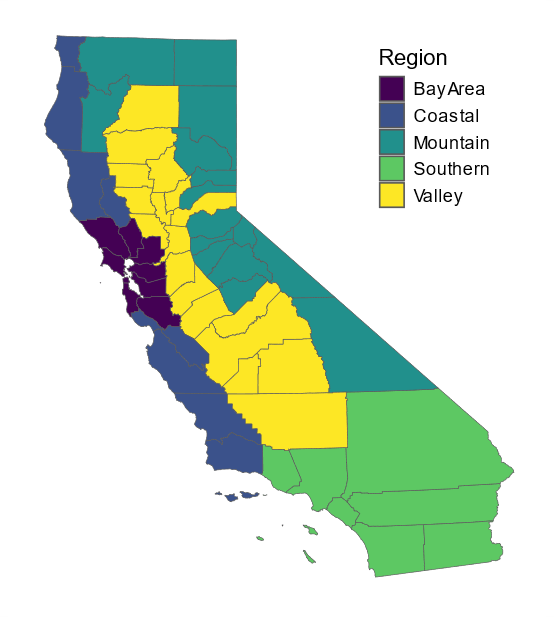
11.
Contract Task Timeline
This contract is estimated to begin January 2025 and end January 2026.
| Task | Task/Deliverable Description | Start Date | End Date |
| 1 | Initial Meeting(s) with CalRecycle | Within seven (7) calendar days of contract execution. | Within thirty-five (35) calendar days of the Initial Meeting. |
| 2 | Monthly and Ad Hoc Meetings throughout the Contract | Within forty-five (45) calendar days of the Initial Meeting. | Monthly until contract end date. |
| 3 |
Execute Approved Engagement Design
|
After the Task 1 Initial Meeting(s). | Completion of Tasks 4 and 5. |
| 4 | Finalization of Current State Reports per Task 4.2, 4.3, and 4.4. | Concurrent with Task 3 | All three Current State reports must be finalized on or before August 29, 2025. |
| 5 | Finalization of Needed State Report | Concurrent with Task 4 | The Needed State report must be finalized on or before October 15, 2025. |
12.
Location of Services
These services will be provided state-wide. The location for meetings with the Contract Manager will be determined by the Contract Manager. Meetings will be held via teleconference, at the California Environmental Protection Agency Headquarters in Sacramento (1001 I Street, Sacramento, CA 95814), or by other appropriate means such as webinar.
13.
Control of Work
- The Contract Manager has the authority to determine the quality and acceptability of the following:
- Work to be performed
- Rate and progress of the work
- Fulfillment of the services provided by the Contractor
-
Compensation for services provided by the Contractor
-
These decisions will be deemed final and enforceable by the Contract Manager when the Contractor fails to complete orders required by this Contract.
-
The Contractor shall promptly bring any unanticipated issues to the attention of the Contract Manager. The Contract Manager will confer with appropriate CalRecycle staff, if necessary, and the Contractor to resolve the issue.
- The Contractor shall designate a Project Manager who holds the following authority:
- Act as the Contractor’s Representative for work to be provided under this Contract
-
Act as the Contractor’s Representative regarding contractual matters relating to this Contract
- If during the Contract, it is necessary to replace the Project Manager, Contract Manager approval is required.
Department of Resources Recycling and Recovery
RFP (S) Number DRR24043
EXHIBIT B: BUDGET DETAIL AND PAYMENT PROVISIONS
Budget Detail and Payment Provisions
-
INVOICING AND PAYMENT:
- For services satisfactorily rendered and upon receipt and approval of the invoices, the State agrees to compensate the Contractor for completed deliverables in accordance with SECTION Exhibit B-1 : COST WORKSHEET and per the terms of the Pay-Per-Deliverable payment structure identified in Exhibit A, Appendix A, Table 1.
-
Itemized invoices shall be submitted electronically, with one set of supporting documentation (i.e., receipts, timesheets, etc), not more frequently than monthly in arrears to:
- Each invoice submitted to CalRecycle must include the following information:
- Invoice Number
- Contract Number
- Description of Rendered Activities/Services including task number
- Submitting Contractor’s Address
- Invoice Period
-
BUDGET CONTINGENCY CLAUSE:
- It is mutually agreed that if the Budget Act of the current year and/or any subsequent years covered under this Agreement does not appropriate sufficient funds for the program, this Agreement shall be of no further force and effect. In this event, the State shall have no liability to pay any funds whatsoever to the Contractor or to furnish any other considerations under this Agreement and the Contractor shall not be obligated to perform any provisions of this Agreement
- If funding for any fiscal year is reduced or deleted by the Budget Act for purposes of this program, the State shall have the option to either: cancel this Agreement with no liability occurring to the State, or offer an Agreement Amendment to the Contractor to reflect the reduced amount.
- PROMPT PAYMENT CLAUSE: Payment will be made in accordance with and within the time specified in Government Code, Chapter 4.5 (commencing with Section 927).
- TAXES: The State of California is exempt from Federal Excise Taxes, and no payment will be made for any taxes levied on employees' wages. The State will pay for any applicable State of California or local sales or use taxes on the services rendered or equipment or parts supplied pursuant to this Agreement. California may pay any applicable sales or use tax imposed by another state.
COST BREAKDOWN: Reference SECTION Exhibit B-1 : COST WORKSHEET
-
TRAVEL CLAUSE: All travel will be reimbursed at the excluded employee travel rates in accordance with the California Code of Regulations Title 2, Division 1, Chapter 3, Subchapter 1, Article 2, Section 599.615.1 et seq. The Contractor will be held to the State per diem rates in effect at the time of travel. For specific per diem (lodging, meals and incidentals) reimbursement rates, see California Code of Regulations Title 2, Division 1, Chapter 3, Subchapter 1, Article 2, Section 599.619. For this agreement, the Contractor’s headquarters are located at <Enter Address>. Per diem will not be reimbursed for travel within 50 miles of Contractor’s headquarters.
If the Contractor is unable to obtain lodging at the excluded employee rate, the Contractor shall request preapproval from the Contract Manager for lodging rates that exceed the allowable rates. Preapproval of excess lodging rates requires the Contractor to complete and submit CalRecycle form 151. The form requires written justification and supporting documentation including a minimum of three lodging quotes to validate the excess lodging rate. The Contract Manager will notify the Contractor of their decision. Excess lodging that is not preapproved will not be reimbursed.
- PAYMENT WITHHOLD: The provisions for payment under this contract will be subject to a ten percent (10%) withholding per invoice. The withheld payment amount will be included in the final payment to the Contractor and will only be released when all required work has been completed to the satisfaction of CalRecycle. The Contractor agrees to comply with the requirements of Public Contract Code (PCC), Section 10346.
- PAY-PER-DELIVERABLE STRUCTURE: This is a “Pay-Per-Deliverable” contract. Individual deliverables that do not meet the contractual requirements specified in the Contract will not be paid at full cost.
Exhibit B-1 : COST WORKSHEET
Winning Cost Sheet will be inserted here.
EXHIBIT C: GENERAL TERMS AND CONDITIONS
GENERAL TERMS AND CONDITIONS
These documents can be viewed at https://www.dgs.ca.gov/OLS/Resources
Department of Resources Recycling and Recovery
RFP (S) Number DRR24043
EXHIBIT D: SPECIAL TERMS AND CONDITIONS
SPECIAL TERMS AND CONDITIONS
-
AGENCY LIABILITY: The Contractor warrants by execution of this Agreement, that no person or selling agency has been employed or retained to solicit or secure this Agreement upon agreement or understanding for a commission, percentage, brokerage, or contingent fee, excepting bona fide employees or bona fide established commercial or selling agencies maintained by the Contractor for the purpose of securing business. For breach or violation of this warranty, CalRecycle shall, in addition to other remedies provided by law, have the right to annul this Agreement without liability, paying only for the value of the work actually performed, or otherwise recover the full amount of such commission, percentage, brokerage, or contingent fee.
-
AMENDMENT: No amendment or variation of the terms of this Agreement shall be valid unless made in writing, signed by the parties and approved as required. No oral understanding or agreement not incorporated in this Agreement is binding on any of the parties. CalRecycle reserves the right to amend this Agreement through a formal written amendment signed by both parties, for additional time and/or funding.
-
CALIFORNIA WASTE TIRES: Unless otherwise provided for in this contract, in the event the Contractor and/or Subcontractor(s) purchases waste tires or waste-tire derived products for the performance of this Agreement, only California waste tires and California waste tire-derived products shall be used. As a condition of payment under this Agreement, the Contractor must provide documentation substantiating the source of the tire materials used during the performance of this Agreement to the Contract Manager.
All formal notices required by this Agreement must be given in writing and sent by prepaid certified mail, fax, personal delivery or telex.
-
CONTRACT MANAGEMENT: The Contractor and the agents and employees of the Contractor, in the performance of this Agreement, shall act in an independent capacity and not as officers or employees or agents of the State of California. The Contractor may change the designated Project Director, but CalRecycle reserves the right to approve any substitution of the Project Director. The Contractor’s key personnel may not be substituted without CalRecycle’s Contract Manager’s prior written approval. CalRecycle may change the Contract Manager by notice given to the Contractor at any time. CalRecycle staff will be permitted to work side-by-side with the Contractor’s staff to the extent and under conditions that may be directed by the Contract Manager. In this connection, CalRecycle’s staff will be given access to all required data, working papers, etc. The Contractor will not be permitted to utilize CalRecycle’s staff for the performance of services, which are the responsibility of the Contractor unless the Contract Manager previously agreed to such utilization in writing, and any appropriate adjustment in price is made. No charge will be made to the Contractor for the services of CalRecycle’s staff for coordination or monitoring functions.
-
CONTRACTOR EVALUATIONS: CalRecycle will evaluate the Contractor’s performance within sixty days of the completion of this Agreement and shall remain on file by CalRecycle for a period of thirty-six months. If the Contractor does not satisfactorily perform the work or service specified in this Agreement, CalRecycle will submit a copy of the negative evaluation to the Department of General Services (DGS), Office of Legal Services, within five (5) working days of the completion of the evaluation. Upon filing an unsatisfactory evaluation with the DGS, CalRecycle shall notify and send a copy of the evaluation to the Contractor within fifteen (15) days. The Contractor shall have thirty days to prepare and send a written response to CalRecycle and the DGS. CalRecycle and the DGS shall file the Contractor's statement with the evaluation. (Public Contract Code, § 10369).
-
CONFIDENTIALITY/PUBLIC RECORDS: The Contractor and CalRecycle understand that each party may come into possession of information and/or data which may be deemed confidential or proprietary by the person or organization furnishing the information or data. Such information or data may be subject to disclosure under the California Public Records Act, commencing with Government Code § 7920.00, or the Public Contract Code (PCC). CalRecycle agrees not to disclose such information or data furnished by the Contractor and to maintain such information or data as confidential when so designated by Contractor in writing at the time it is furnished to CalRecycle, only to the extent that such information or data is exempt from disclosure under the California Public Records Act and the PCC.
-
CONFLICT-FUTURE BIDDING LIMITATION AND FOLLOW-ON CONTRACTS: Pursuant to PCC § 10365.5:
- No person, firm, or subsidiary thereof who has been awarded a consulting services contract may submit a bid for, nor be awarded a contract for, the provision of services, procurement of goods or supplies, or any other related action that is required, suggested, or otherwise deemed appropriate in the end product of the consulting services contract.
- Subdivision (a) does not apply to any person, firm, or subsidiary thereof who is awarded a subcontract of a consulting services contract that amounts to no more than ten (10) percent of the total monetary value of the consulting services contract.
-
Subdivisions (a) and (b) do not apply to consulting services contracts subject to Chapter 10 (commencing with Section 4525) of Division 5 of Title 1 of the Government Code.
-
CONSULTING SERVICES: If this Agreement is for consulting services, the Contractor is hereby advised of its duties, obligations and rights under PCC §§ 10335 through 10381.
-
DELIVERABLES: All documents and/or reports drafted for publication by or for CalRecycle in accordance with this contract shall adhere to CalRecycle’s Contractor Publications Guide at www.calrecycle.ca.gov/Contracts/PubGuide/ and shall be reviewed by CalRecycle’s Contract Manager in consultation with a CalRecycle editor.
For contracts of $5,000 or more, any document or written report prepared for or under the direction of CalRecycle, shall include a notation on the inside cover as follows:
"Prepared as part of CalRecycle contract number <<INSERT>>, Total Contract Amount <<INSERT>>, pursuant to Government Code § 7550."
-
ENTIRE AGREEMENT: This Agreement supersedes all prior agreements, oral or written, made with respect to the subject hereof and, together with the Attachments and/or Exhibits hereto, contains the entire Agreement of the parties.
-
ENVIRONMENTAL JUSTICE: In the performance of this Agreement, the Contractor shall conduct its programs, policies, and activities that substantially affect human health or the environment in a manner that ensures the fair treatment of people of all races, cultures, and income levels, including minority populations and low-income populations of the State. (Gov. Code, § 65040.12(e).)
-
EXECUTIVE ORDER N-6-22 – RUSSIA SANCTIONS: On March 4, 2022, Governor Gavin Newsom issued Executive Order N-6-22 regarding Economic Sanctions against Russia and Russian entities and individuals. “Economic Sanctions” refers to sanctions imposed by the U.S. government in response to Russia’s actions in Ukraine, as well as any sanctions imposed under state law. By submitting a bid or proposal, the Contractor represents that it is not a target of Economic Sanctions. Should the State determine that the Contractor is a target of Economic Sanctions or is conducting prohibited transactions with sanctioned individuals or entities, that shall be grounds for rejection of the Contractor’s bid/proposal any time prior to contract execution, or, if determined after contract execution, shall be grounds for termination by the State.
-
FORCE MAJEURE: Neither CalRecycle nor the Contractor, including the Contractor's subcontractor(s), if any, will be responsible hereunder for any delay, default or nonperformance of this Agreement, to the extent that such delay, default or nonperformance is caused by an act of God, weather, accident, labor strike, fire, explosion, riot, war, rebellion, sabotage, or flood, or any other cause beyond the reasonable control of such party.
-
GENERATIVE ARTIFICAL INTELLIGENCE (GenAI) TECHNOLOGY USE AND REPORTING: During the term of the contract, the Contractor must notify the State in writing if their services or any work under this contract includes, or makes available, any previously unreported GenAI technology, including GenAI from third parties or subcontractors. The Contractor shall immediately complete the GenAI Reporting and Factsheet (STD 1000) to notify the State of any new or previously unreported GenAI technology. At the direction of the State, the Contractor shall discontinue the use of any new or previously undisclosed GenAI technology that materially impacts functionality, risk or contract performance, until use of such GenAI technology has been approved by the State.
Failure to disclose GenAI use to the State and submit the GenAI Reporting and Factsheet (STD 1000) may be considered a breach of the contract by the State at its sole discretion and the State may consider such failure to disclose GenAI and/or failure to submit the GenAI Reporting and Factsheet (STD 1000) as grounds for the immediate termination of the contract. The State is entitled to seek any and all relief it may be entitled to as a result of such non-disclosure.
The State reserves the right to amend the contract, without additional cost, to incorporate GenAI Special Provisions into the contract at its sole discretion and/or terminate any contract that presents an unacceptable level of risk to the State.
-
GRATUITIES: CalRecycle may terminate this Agreement if gratuities were offered or given by the Contractor, or any agent or representative of the Contractor, to any employee of CalRecycle, with a view toward securing a contract or securing favorable treatment with respect to awarding or amending or making a determination with respect to performance of this Agreement.
-
HEALTH AND SAFETY: Contractors are required to, at their own expense, comply with all applicable health and safety laws and regulations. Upon notice, Contractors are also required to comply with CalRecycle’s specific health and safety requirements and policies. Contractors agree to include in any subcontract related to performance of this Agreement, a requirement that the subcontractor comply with all applicable health and safety laws and regulations, and upon notice, CalRecycle’s specific health and safety requirements and policies.
-
IMPRACTICABILITY OF PERFORMANCE: This Agreement may be suspended or cancelled, without notice at the option of the Contractor, if the Contractor’s or CalRecycle’s premises or equipment is destroyed by fire or other catastrophe or is so substantially damaged that it is impractical to continue service or in the event the Contractor is unable to render service as a result of any action by any governmental authority.
-
INSURANCE: When required, the Contractor must provide: 1) a Certificate of Insurance insuring CalRecycle, and/or 2) verification of Worker’s Compensation insurance. The Contractor must provide said Certificate of Insurance and/or verification to CalRecycle within ten (10) days after notification of CalRecycle’s intent to award the Agreement. The Agreement will not be executed, nor can work begin, unless said Certificate of Insurance and/or verification is provided to CalRecycle.
The Certificate of Insurance must be in effect for the duration of the Agreement and shall include the following terms and conditions:
- CalRecycle, its officers, agents, employees, and servants shall be included as additional insured.
- The dates of inception and expiration of coverage shall be specified.
- A minimum liability coverage of not less than $1,000,000.00 per occurrence for bodily injury and property damage liability combined shall be specified. The coverage shall not include a deductible feature.
- The insurer will not cancel the insured’s coverage without thirty days prior written notice to CalRecycle.
- CalRecycle is not liable for the payment of premiums or assessments on said policy.
- The insurance coverage shall be on an occurrence basis only.
In the event the Certificate of Insurance should expire or be cancelled during the term of this Agreement, the Contractor agrees to provide, at least thirty days prior to said expiration or cancellation, a new Certificate of Insurance evidencing coverage, as provided for herein, for not less than one (1) year or for the remainder of the contractual agreement, whichever is greater. In the event the Contractor fails to keep in effect at all times insurance coverage as herein provided, CalRecycle may, in addition to any other remedies it may have, terminate this Agreement upon occurrence of such event.
-
INTELLECTUAL PROPERTY: CalRecycle shall exclusively own all intellectual property rights in and to all work product, including, but not limited to, writings, ideas, inventions (whether patentable or not), discoveries, research, proposals, and all other results and work product of any nature whatsoever, that is created, authored, produced, conceived, or reduced to practice in the course of the performance of this Agreement. Such intellectual property rights, whether registered or unregistered, and including all applications for and renewals or extensions thereof, shall include, but are not necessarily limited to copyrights; trademarks, service marks, trade dress, trade names, logos, and domain names, together with all of the goodwill associated therewith; and patents. The Contractor agrees, and shall cause all of its relevant personnel, including all employees, agents, subcontractors, and other personnel participating in any way in the creation or achievement of such work product, to agree, that any such work product that may qualify as “work made for hire” pursuant to 17 U.S.C. § 101 is hereby deemed a “work made for hire” for CalRecycle. To the extent that any of the work product does not constitute a “work made for hire” for CalRecycle, Contractor hereby irrevocably assigns to CalRecycle, and shall cause such personnel to irrevocably assign to CalRecycle, in each case without additional consideration, all rights, title, and interest throughout the world in and to the work product, including all intellectual property rights therein. Upon request of CalRecycle, the Contractor shall promptly take, and shall cause its relevant personnel to promptly take, such further actions, including execution and delivery of all appropriate instruments of conveyance, as may be necessary to assist CalRecycle to prosecute, register, perfect, or record its rights in or to any such work product.
-
LIABILITY FOR NONCONFORMING WORK: The Contractor will be fully responsible for ensuring the completed work conforms to the agreed upon terms. If nonconformity is discovered prior to the Contractor’s deadline, the Contractor will be given a reasonable opportunity to cure the nonconformity. If the nonconformity is discovered after the deadline for the completion of the project, CalRecycle, in its sole discretion, may use any reasonable means to cure the nonconformity. The Contractor shall be responsible for reimbursing CalRecycle for any additional expenses incurred to cure such defects.
-
LICENSES OR PERMITS: The Contractor shall be an individual or firm licensed to do business in and with the State of California and shall obtain at his/her expense all license(s) and permit(s) required by law for accomplishing any work required in connection with this Agreement.
In the event the Contractor fails to keep in effect at all times all required license(s) and permit(s), CalRecycle may, in addition to other remedies it may have, terminate this Agreement upon occurrence of such event.
-
ORDER OF PRECEDENCE: In the event of conflict or inconsistency between the articles, exhibits, attachments, specifications or provisions that constitute this Agreement, the following order of precedence shall apply: STD 213; GTC 04/2017 – General Terms and Conditions (incorporated by reference); Exhibit A – Scope of Work; Exhibit B – Budget Detail and Payment Provisions; Exhibit B.1 – Cost Sheet; Exhibit D – Special Terms and Conditions; Other exhibits in alphabetical order, beginning with E; Attachments in numerical order, beginning with 1.
-
OWNERSHIP OF DRAWINGS, PLANS AND SPECIFICATIONS: CalRecycle will have separate and independent ownership of all drawings, design plans, specifications, notebooks, tracings, photographs, negatives, reports, findings, recommendations, data and memoranda of every description or any part thereof, prepared under this Agreement. The originals and all copies thereof will be delivered to CalRecycle upon request. CalRecycle will have the full right to use said originals and copies in any manner when and where it may determine without any claim on the part of the Contractor, its vendors or subcontractors to additional compensation.
-
PUBLICITY AND ACKNOWLEDGEMENT: The Contractor shall acknowledge CalRecycle’s support whenever projects funded, in whole or in part, by this Agreement are publicized in any news media, brochures, or other type of promotional material.
-
RECYCLED-CONTENT PRODUCT PURCHASING: In the performance of this Agreement, the Contractor shall purchase used and/or recycled-content products as set forth on the back of the Recycled-Content Certification Form (Exhibit D, Attachment 1). For assistance in locating recycled-content products, please search the recycled-content product database available at: www.calrecycle.ca.gov/rcpm. If after searching the database, contractors are unable to find the recycled-content products they are looking for, please notify CalRecycle’s Contract Manager. All recycled content products purchased or charged/billed to CalRecycle that are printed upon such as promotional items, publications, written materials, and other educational brochures shall have both the total recycled content (TRC) and the post-consumer (PC) content clearly printed on them.
In addition, any written documents such as, publications, letters, brochures, and/or reports shall be printed double-sided on 100% post-consumer (PC) paper. Specific pages containing full-color photographs or other ink-intensive graphics may be printed on photographic paper. The paper should identify the post-consumer recycled content of the paper (i.e., “printed on 100% post-consumer paper”). When applicable, the Contractor shall provide the Contract Manager with an electronic copy of the document and/or report for CalRecycle’s uses. When appropriate, only an electronic copy of the document and/or report shall be submitted and no hard copy shall be provided.
-
REMEDIES: The Contractor shall perform all work pursuant to the Agreement in a safe, satisfactory, professional, efficient, and expeditious manner to the satisfaction of CalRecycle. Unless otherwise expressly provided herein, the rights and remedies hereunder are in addition to, and not in limitation of, other rights and remedies under the Agreement, at law or in equity, and exercise of one right or remedy will not be deemed a waiver of any other right or remedy. In the event of the Contractor’s default under this Agreement, CalRecycle shall be entitled to all remedies available at law including, but not limited to, termination of this Agreement, withholding of any amount billed, and/or recovery of funds disbursed.
-
SETTLEMENT OF DISPUTES: In the event of a dispute, the Contractor shall file a “Notice of Dispute” with CalRecycle’s Director or his/her designee with ten (10) days of discovery of the problem. Within ten (10) days, the Director or his/her designee shall meet with the Contractor and CalRecycle Project Manager for the purpose of solving the dispute.
-
STOP WORK NOTICE: Immediately, upon receiving a written notice to stop work, the Contractor shall cease all work under this Agreement.
-
SUBCONTRACTORS: All Subcontractors previously identified in the bid/proposal submitted are considered to be acceptable to CalRecycle. Any change or addition of Subcontractors will be subject to the prior written approval of the Contract Manager or the Director or his/her designee. Upon termination of any Subcontract, the Contractor shall notify the Contract Manager or the Executive Director immediately. If CalRecycle or the Contractor determines that the level of expertise or the services required are beyond that provided by the Contractor or its routine Subcontractors, the Contractor shall be required to employ additional Subcontractors. Nothing contained in this Agreement or otherwise, shall create any contractual relation between CalRecycle and any Subcontractors, and no Subcontract shall relieve the Contractor of its responsibilities and obligations hereunder. The Contractor agrees to be as fully responsible to CalRecycle for the acts and omissions of its Subcontractors and of persons either directly or indirectly employed by any Subcontractor as it is for the acts and omissions of persons directly employed by the Contractor. The Contractors obligation to pay its Subcontractors is an independent obligation from CalRecycle’s obligation to make payments to the Contractor. As a result, CalRecycle shall have no obligation to pay or to enforce the payment of any moneys to any Subcontractor.
-
SUCCESSORS: The provisions of this Agreement will be binding upon and inure to the benefit of CalRecycle, the Contractor, and their respective successors.
-
TERMINATION: CalRecycle shall have the right to terminate this Agreement at its sole discretion at any time upon thirty (30) days written notice given to the Contractor. In the case of early termination, a final payment will be made to the Contractor upon approval by the Contract Manager of a financial report, invoices for costs incurred to date of termination and a written report describing all work performed by the Contractor to date of termination.
-
UNRELIABLE LIST: Prior to authorizing a Subcontractor(s) to commence work under this Agreement, the Contractor shall submit to CalRecycle a declaration from the Subcontractor(s), signed under penalty of perjury, stating that within the preceding three years, none of the events listed in Section 17050 of Title 14, California Code of Regulations, Natural Resources, Division 7, have occurred with respect to the subcontractor(s).
Placement of the Contractor on CalRecycle’s Unreliable List at any time after award of this Agreement may be grounds for termination of Agreement. If a Subcontractor is placed on CalRecycle’s Unreliable List after award of this Agreement, the Contractor may be required to terminate the Subcontract.
- WASTE REDUCTION: In the performance of this Agreement, the Contractor shall take all reasonable steps to ensure that materials purchased or consumed in the course of the project are utilized both effectively and efficiently to minimize the generation of waste. The steps should include, but not necessarily be limited to, the use of reusable products, the use of recyclable and compostable products, discretion in the amount of materials used, the provision of alternatives to disposal for materials consumed, and the practice of other waste reduction measures where feasible and appropriate.
Department of Resources Recycling and Recovery
RFP (S) Number DRR24043
EXHIBIT E: RECYCLED CONTENT CERTIFICATION
Please click the button below to download the attached file.
Department of Resources Recycling and Recovery
RFP (S) Number DRR24043
ATTACHMENT 16: FINAL PROPOSAL CHECKLIST
FINAL PROPOSAL CHECKLIST
Please use this checklist to assist in the preparation of your Proposal package to ensure that all required items are included.
- Cover Letter with contact information and statements as required in the RFP.
- Organizational information and Personnel Information (Resumes)
- Proposal (detailed Work Plan or Study Design)
- Samples of Written Work
- Copy of Required License(s) (Secretary of State)
The following forms are only required upon submittal as applicable pursuant to the provisions outlined in Section III, SECTION 3. PROPOSAL SUBMITTAL REQUIREMENTS :
Certification of Target Area Contract Preference Act (The form may be downloaded at https://www.documents.dgs.ca.gov/dgs/fmc/pdf/std830.pdf)
Bidder's Summary of Contract Activities and Labor Hours (The form may be downloaded at https://www.documents.dgs.ca.gov/dgs/fmc/gs/pd/gspd0526.pdf)
The following forms are not required at the time of the Proposal submission but are part of the draft Standard Agreement (Attachment I) and will be required by the successful Contractor during the contract period:
- ATTACHMENT 2: SMALL BUSINESS (SB) SUBCONTRACTOR PAYMENT CERTIFICATION
- ATTACHMENT 3: DISABLED VETERAN BUSINESS SUBCONTRACTOR PAYMENT CERTIFICATION
- EXHIBIT E: RECYCLED CONTENT CERTIFICATION
- Payee Data Record (Standard Form 204 viewable at https://www.calrecycle.ca.gov/Contracts/Forms/default.htm)
Please note that if any of the items are missing from the Proposal package, the package will be considered incomplete and will be disqualified from the process.
Cover Letter with contact information and statements as required in the RFP.
All files must be combined into one (1) .ZIP file before uploading.